
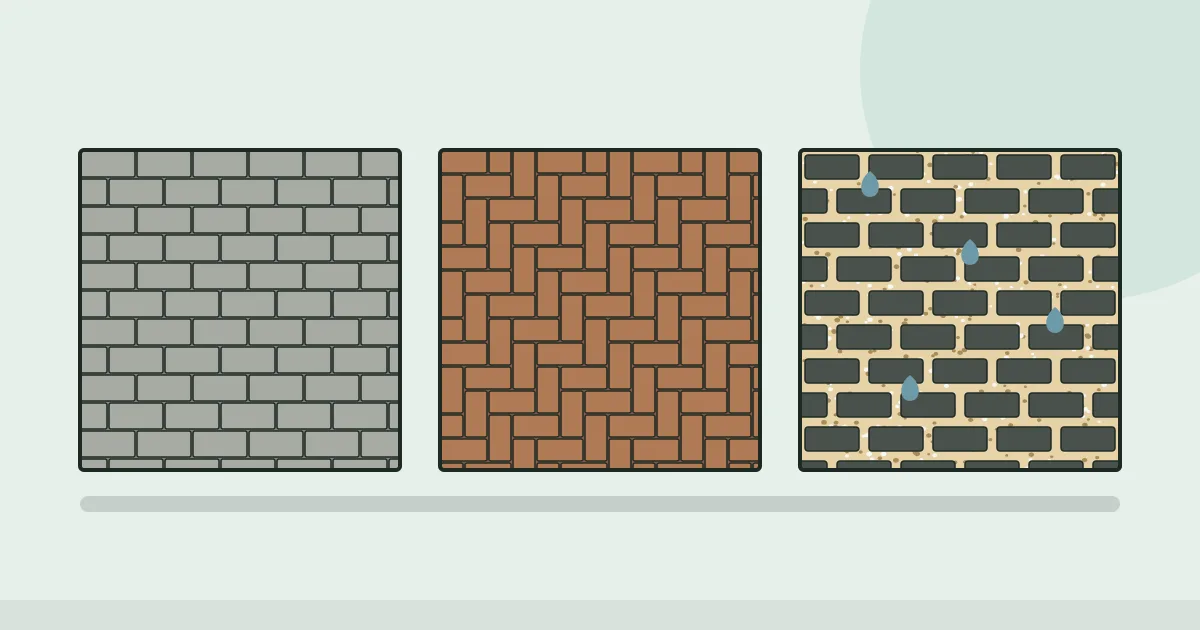
We compare the three main types of block used on UK driveways by what they're made of and how they behave. We don't name or rank manufacturers, and we haven't tested any products ourselves. Quality varies within each type, so ask your installer to show you the specific block and its specification before you commit.
"Block paving" covers three quite different products. Concrete blocks are moulded from concrete and are by far the most common. Clay pavers are fired like bricks. Permeable blocks are usually concrete too, but shaped and laid so water drains through the joints. The choice affects price, how the drive looks in fifteen years, and whether you need planning permission. It also changes the sub-base underneath, which is easy to overlook.
The three types at a glance
Concrete, clay and permeable block paving compared. Price position is relative, within the £3,000–£7,000+ range on our block paving page.
| Concrete blocks | Clay pavers | Permeable blocks | |
|---|---|---|---|
| Relative price | Lowest | Highest | Above standard concrete |
| Colour over time | Fades gradually as the surface wears | Colour runs through the paver; holds it well | As concrete blocks |
| Range of styles | Very wide, including tumbled and stone-effect | Narrower, mainly reds, browns and brindles | Narrower than standard concrete |
| Joints | Narrow, filled with sand | Narrow, filled with sand | Wider, filled with open grit |
| Planning (England, front garden) | Impermeable: over 5 m² needs drainage to your own land or an application | Impermeable, as concrete | Permeable: generally no application |
| Sub-base | Standard Type 1 | Standard Type 1 | Open-graded stone that stores water |
| Cutting | Straightforward with a saw | Harder, denser material | As concrete blocks |
Concrete blocks
Most block paved drives in the UK are concrete. The range is huge: smooth or textured faces, tumbled blocks with rounded edges for an aged look, multi-tone blends, and styles that imitate setts or natural stone. Because they're moulded, sizes are very consistent, which makes them quicker to lay.
The trade-off is colour. The colour in most concrete blocks comes from pigment in the mix, and the surface weathers over the years to reveal more of the aggregate beneath, so they slowly fade and dull. Better-quality blocks often hold up noticeably longer than the cheapest ones. This is the main reason our block paving cost guide puts concrete at the lower end of the range.
Clay pavers
Clay pavers are made from fired clay, like a brick, and the colour is part of the material rather than added to it. They keep their colour much longer than most concrete blocks, which is the main thing you're paying extra for. They suit period houses and anywhere you want the drive to match old brickwork.
They're harder and denser, so cutting takes longer, and sizes can vary slightly more than with concrete. The colour range is narrower, mostly reds, browns, buffs and brindles. Clay pavers with a herringbone pattern or feature border are what pushes a drive into the top band on our block paving driveways page.
Permeable blocks
Permeable blocks have spacer nibs or shaped edges that leave wider joints, and those joints are filled with a fine open grit rather than sand. Water drains through the joints into a sub-base of open-graded stone, which stores it while it soaks into the ground or drains away. That's what lets a permeable block drive avoid the English front-garden planning rule. Our guide to permeable vs impermeable driveways covers the rule itself.
The extra cost isn't just the blocks. The sub-base is different from a standard drive and often deeper, and on heavy clay the system may need an outlet because the ground can't take the water fast enough. A "permeable" drive laid on standard Type 1 with sand in the joints is just block paving. Interpave, the precast concrete paving trade association, publishes guidance on permeable paving if you want to read more.
Laying pattern: the other cost decision
- Stretcher or running bond. Rows of blocks offset by half a block. Quickest to lay with the fewest cuts, so the cheapest. Best laid across the direction of traffic.
- Herringbone. Blocks at right angles in a zigzag, at 90° or 45° to the edge. It's widely regarded as the strongest pattern for vehicle traffic because the blocks interlock in every direction. The 45° version needs the most cutting at the edges.
- Basketweave. Pairs of blocks alternating direction. A traditional look, but less interlock than herringbone, so it's more often used on paths and patios than busy drives.
- Borders and banding. A contrasting edge course or bands across the drive. Extra cutting and labour, but they also act as the edge restraint.
If you're still deciding between block paving and a bound surface, our comparison of resin bound vs block paving sets the two side by side.
Frequently asked questions
Are clay pavers worth the extra cost?
They are if long-term colour matters to you. Clay holds its colour much longer than most concrete blocks, which fade gradually. If you're happy with a wide choice of styles and expect some weathering, good-quality concrete blocks are the more economical option.
Do permeable blocks need a special sub-base?
Yes. They need an open-graded stone sub-base that lets water through and stores it, rather than the standard Type 1 used under ordinary block paving. Laying permeable blocks on a standard sub-base defeats the point.
Which block paving pattern is strongest for a driveway?
Herringbone is generally considered the strongest for vehicle traffic because the blocks interlock in every direction. Stretcher bond is cheaper to lay and works well on many domestic drives when laid across the direction of travel.
How thick should driveway block paving be?
Blocks around 50mm thick are common on domestic driveways, with thicker blocks used for heavier traffic. Check that the block you choose is intended for vehicle use and ask the installer to confirm the thickness on the quote.
Ready to talk to a block paving driveways specialist?
Get Free Quotes →