
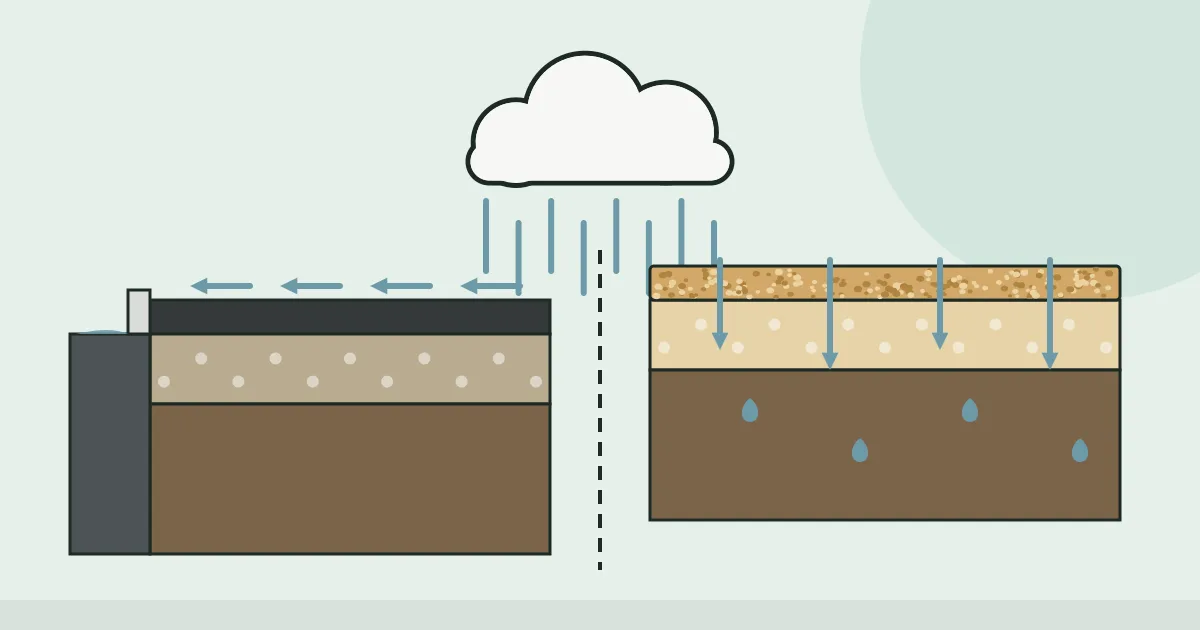
Whether a new front driveway needs planning permission in England rarely comes down to how big it is or what it looks like. It comes down to where the rain goes. Surfaces that let water soak through are treated one way, and surfaces that shed it are treated another. Every one of the six surfaces we cover sits on one side of that line or the other, and a couple of them can sit on either side depending on how they're built.
This guide sorts them, explains the three ways a sealed surface can still go ahead without an application, and covers the cases where a surface sold as permeable stops behaving like one.
The rule, in one paragraph
For a house in England, hard surfacing in the front garden (anything between the house's principal elevation and the highway) is permitted development if it's porous, or if its rainwater ends up in a lawn, border or soakaway on your own land. An impermeable surface larger than 5 square metres that sheds water onto the pavement or road needs planning permission. That applies to a replacement drive as well as a brand-new one. The Planning Portal's guide to paving a front garden sets this out, and the legal wording is Class F of the General Permitted Development Order.
Away from the front garden there's no area limit on ground-level hard surfacing, though major embanking or terracing to support it can need an application. Flats, maisonettes, listed buildings and homes where permitted development rights have been removed are outside these rules altogether.
Sorting the six surfaces
How each driveway surface is usually treated under the English front-garden rule. The build underneath matters as much as the top layer.
| Surface | Usually treated as | What can change that |
|---|---|---|
| Gravel | Permeable | Laid over concrete or old tarmac rather than a free-draining sub-base |
| Resin bound | Permeable | Laid over a sealed, non-draining base, so water passes through the resin and then has nowhere to go |
| Permeable block paving | Permeable | Joints filled with sand instead of the open grit the system was designed for |
| Standard block paving | Impermeable | Can stay legal by draining to a border, lawn or soakaway |
| Slabs with mortar joints | Impermeable | Permeable jointing or a soakaway; slabs themselves don't drain |
| Tarmac | Impermeable | Porous asphalt exists and is treated as permeable, but standard dense tarmac is not |
| Concrete | Impermeable | Falls to a border or soakaway, or channel drainage to one |
Gravel, resin bound and permeable blocks are the three surfaces people usually pick because of this rule. Our guide to the types of driveway compares all six on price and upkeep, and the gravel driveway cost guide shows why gravel is often the cheapest way to keep a large frontage permeable.
Three ways an impermeable drive avoids an application
Choosing tarmac, concrete or standard block paving doesn't commit you to a planning application. It commits you to dealing with the water. There are three routes:
- Keep it to 5 square metres or less. That's roughly a single parking bay's worth of paving, so it rarely suits a full drive, but it can cover a path or a small extension to an existing drive.
- Fall it towards your own garden. The drive is laid with a gentle slope towards a lawn or planted border that soaks up the run-off. This only works if that ground genuinely takes the water. Heavy clay that stays waterlogged after rain may not.
- Collect it and send it to a soakaway. A linear drain at the low end of the drive catches the water and carries it to a soakaway, a rain garden or a permeable strip within your boundary. This adds groundwork, and the soakaway needs to be sized for the area it serves.
Whichever route a contractor proposes, ask them to say on the quote how the drive will drain and where the water ends up. "Falls to the road gully" on a 30 square metre concrete drive is a planning application, not a detail. Our guide to comparing driveway quotes lists the other lines a quote should spell out.
When a permeable surface stops counting
A surface is only as permeable as the layers beneath it. These are the cases that catch people out:
- Resin over old tarmac or concrete. The resin layer drains, but the sealed base under it doesn't, so water runs along the top of the old surface and out at the lowest edge. A resin overlay on an existing drive is often still the right job, but it needs its own drainage plan.
- Resin bonded instead of resin bound. Bonded surfaces have stone scattered onto a layer of resin, which forms a sealed skin. It isn't permeable in the way resin bound is.
- Gravel or blocks on a concrete slab. Laying a permeable top over a solid base, often to save digging out an old drive, leaves the water with nowhere to go.
- Blocked pores and joints. Silt, moss and detritus slowly clog resin and permeable block joints. The surface still counts as permeable on paper, but puddles start to form. Our driveway maintenance guide covers how to keep each surface draining.
- Ground that won't take water. Permeable surfaces drain into the sub-base and then the soil. On heavy clay the sub-base may need to be deeper to store water, or the system may need an outlet. That's a design question for the installer, covered in our driveway sub-base guide.
Scotland, Wales and Northern Ireland
The 5 square metre rule described above is the English one. Scotland, Wales and Northern Ireland each set their own permitted development rules, and they don't all match it. Wales publishes its guidance through gov.wales, and in Northern Ireland planning is handled by the local council with policy set by the Department for Infrastructure. Wherever you are outside England, check with your local planning authority before assuming a sealed drive is fine or a permeable one is exempt.
Other permissions that sit alongside planning
- A dropped kerb. Driving across a pavement needs a lowered kerb and the council's consent, whatever the drive is made of. You apply through your local council in England and Wales, and the kerb and crossover are priced separately from the drive itself.
- Conservation areas and Article 4 directions. Some councils remove permitted development rights for front gardens, so even a gravel drive can need an application.
- Listed buildings. Bigger works at a listed property may also need listed building consent, a separate process from planning. The Planning Portal's listed building page explains when.
- New parking for an electric car. If the new drive is mainly about charging at home, the cable route and dropped kerb come into the same plan. Our guide to getting a driveway ready for an electric car covers the order to do things in.
For the construction detail, including soakaways and rain gardens, the original source is the front-garden permeable surfacing guidance on gov.uk.
How to check whether a new front driveway needs planning permission in England
- Confirm the property type
The front-garden permitted development rule applies to houses. Flats, maisonettes and some converted homes don't have it, so check before going further.
- Rule out local restrictions
Find out from the council whether the property is listed, in a conservation area, or covered by an Article 4 direction or a planning condition that removes permitted development rights.
- Measure the area being surfaced
Work out the area of new or replacement hard surfacing in the front garden, from the house wall out to the pavement. Five square metres or less is permitted development whatever the surface.
- Identify the surface and the base
Find out whether the proposed surface is permeable (gravel, resin bound, permeable block, porous asphalt) and whether the layers beneath it let water drain away.
- Trace where the water goes
For an impermeable surface over 5 square metres, confirm whether it falls to a lawn, border or soakaway on your own land. If it drains onto the pavement or road, planning permission is needed.
- Apply separately for a dropped kerb
If you'll be driving across a pavement, apply to the council's highways team for a dropped kerb, whatever the planning answer is.
Frequently asked questions
Does block paving count as permeable for planning?
Standard block paving with sand-filled joints is treated as impermeable. Permeable block paving is a different system, with wider joints filled with open grit over a free-draining sub-base, and it is treated as permeable. Ask the installer which one is being quoted.
Does a replacement driveway need planning permission?
It can. The English rule covers new and replacement hard surfacing in a front garden, so relaying an old concrete drive in impermeable material over 5 square metres, draining onto the road, needs permission in the same way a new one would.
Is tarmac ever permeable?
Porous asphalt is made to let water through and is treated as permeable, but it is a specialist product. The standard dense tarmac used on most domestic drives is impermeable and needs to drain to your own garden or a soakaway to avoid an application.
What happens if I lay an impermeable driveway without permission?
You may be asked for a retrospective application. If that's turned down, the council can require changes, such as adding drainage or relaying the drive in a permeable material. It can also come up when you sell, as buyers' solicitors ask about planning for recent work.
Ready to talk to an asphalt/tarmac driveways specialist?
Get Free Quotes →