
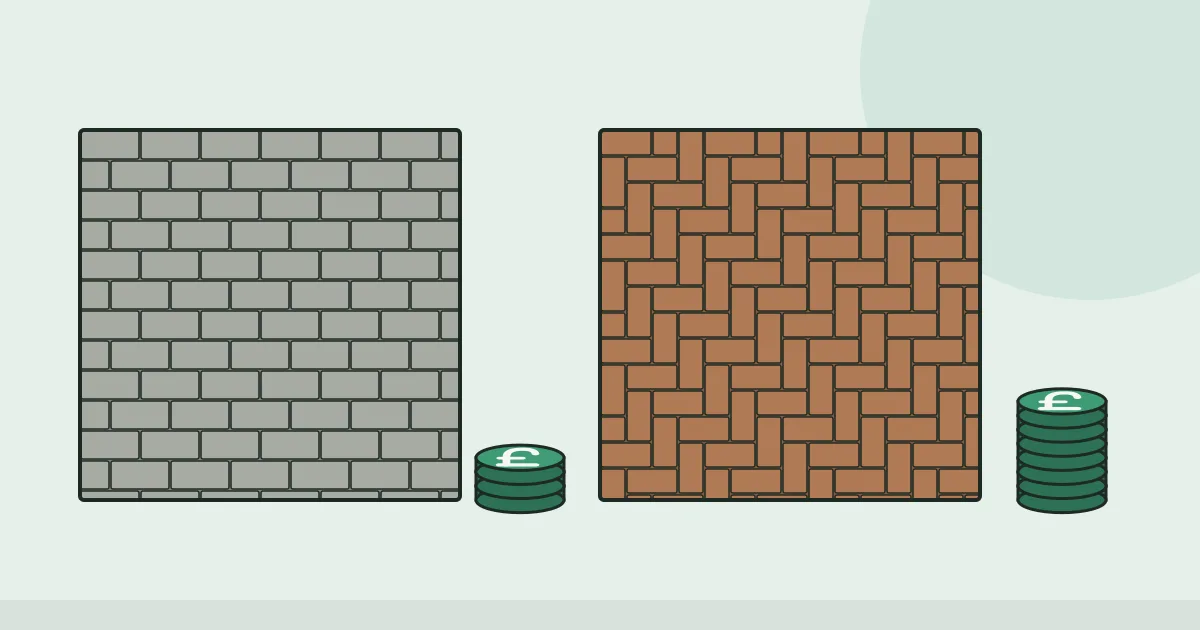
A block paving driveway in the UK typically costs between £3,000 and £7,000 installed. It sits towards the top of the price range for driveway surfaces because every block is laid by hand, one at a time, over a screeded sand bed. The labour that makes it expensive is also what gives it its main advantage: any single block can be lifted and relaid later without touching the rest of the drive.
Because the cost is mostly hand labour, the price of block paving responds to decisions you make at the design stage more than any other surface does. Pattern, block type and the shape of the drive all change how many hours the job takes. This guide explains how. The installation process itself is covered on our block paving driveways page.
Block paving prices by size
Typical UK installed prices for a block paving driveway, including excavation, sub-base, edge courses, sand bed, blocks and jointing. Figures vary with region, block choice and ground conditions.
| Driveway size | Typical scope | Typical cost |
|---|---|---|
| Small (single car) | Standard concrete blocks, a simple laying pattern, edging on both sides and reasonable access | £3,000 – £4,500 |
| Medium (two cars) | A larger rectangle or gentle curve, mid-range blocks, a contrasting border course | £4,500 – £6,000 |
| Large, feature pattern or clay pavers | A full frontage, herringbone or basketweave, clay pavers or banded designs, more cutting around features | £6,000 – £7,000+ |
Why pattern changes the price
The same area and the same blocks can produce noticeably different quotes depending on how they're arranged. A stretcher or running bond, where blocks sit in straight staggered rows, is the quickest to lay and produces the fewest cuts. Herringbone, laid at 45 or 90 degrees, locks together more strongly under turning tyres, which is why many installers recommend it for drives. But it needs a cut block at every edge, and every one of those cuts is time with a saw. Basketweave and mixed-size random patterns sit somewhere between.
Shape matters in the same way. A rectangular drive with straight edges needs fewer cuts than one that curves round a flower bed, steps around a bay window or has manhole covers in the middle. If you're trying to keep block paving within budget, simplifying the outline often saves more than choosing a cheaper block.
Concrete blocks, clay pavers and permeable blocks
- Concrete blocks are the most common and the most affordable. They come in a very wide range of colours and textures, including finishes made to look like natural stone. Colours on some concrete blocks can fade over the years.
- Clay pavers cost more per square metre and push a job towards the top band. Their colour runs right through the unit and doesn't fade in the same way.
- Permeable blocks are laid with wider joints filled with a free-draining material, so rainwater soaks through. They can cost more, but they may avoid a planning application or a drainage channel, which can make them the cheaper route overall on a front drive.
Two block paving quotes can differ by a thousand pounds and still both be fair. One may price a simple stretcher bond in standard grey concrete blocks, the other herringbone in brindle blocks with a double border. Ask each installer to name the block, the pattern, the edging and the sub-base depth, then compare those line by line.
Planning, drainage and the hidden extras
Standard block paving with sand joints counts as impermeable. In England, more than 5 square metres of it in a front garden, draining onto the road, needs planning permission unless the water goes to your own garden or a soakaway. Many quotes solve this with a channel drain across the entrance. Permeable block paving is generally exempt. The gov.uk guidance on paving a front garden has the detail, and the rules are set separately in Scotland, Wales and Northern Ireland. Beyond planning, budget for any dropped kerb (a separate council consent), raising manhole covers to the new level, and removing an old surface if one is there.
What block paving costs over its life
A well-laid block drive typically lasts 20–25 years. Its main upkeep is topping up the jointing sand and dealing with weeds in the joints. Upfront, it usually costs more than tarmac and is often close to resin bound. Being able to repair a sunken area block by block, rather than patching a continuous surface, is what many owners are paying for. Our guide to the types of driveway sets block paving against the other five surfaces, and the driveway surface cost calculator will show you where it lands for your size of drive.
Frequently asked questions
Is block paving more expensive than tarmac?
Generally yes. Tarmac goes down as one continuous layer, while block paving is laid by hand unit by unit, so for the same area block paving usually costs more. A single-car block drive typically starts around £3,000, against around £2,500 for tarmac.
Does herringbone block paving cost more?
Usually a little, because every edge needs cut blocks and cutting takes time. On a simple rectangular drive the difference can be modest. On a curved or awkwardly shaped drive it grows. Many installers still recommend herringbone for driveways because it resists creeping under turning tyres better than a straight bond.
Can I reuse my old block paving to save money?
Sometimes. If the blocks themselves are sound and the problem is a sunken area or a failed sub-base, they can often be lifted, the base corrected and the same blocks relaid, which saves on materials. Faded, cracked or oil-stained blocks are usually better replaced.
How long does a block paving driveway take to lay?
Typically three to five days for a domestic drive: excavation and sub-base first, then edge courses, the sand bed, laying and cutting, and finally compaction and jointing. Larger drives and intricate patterns take longer.
Ready to talk to a block paving driveways specialist?
Get Free Quotes →