
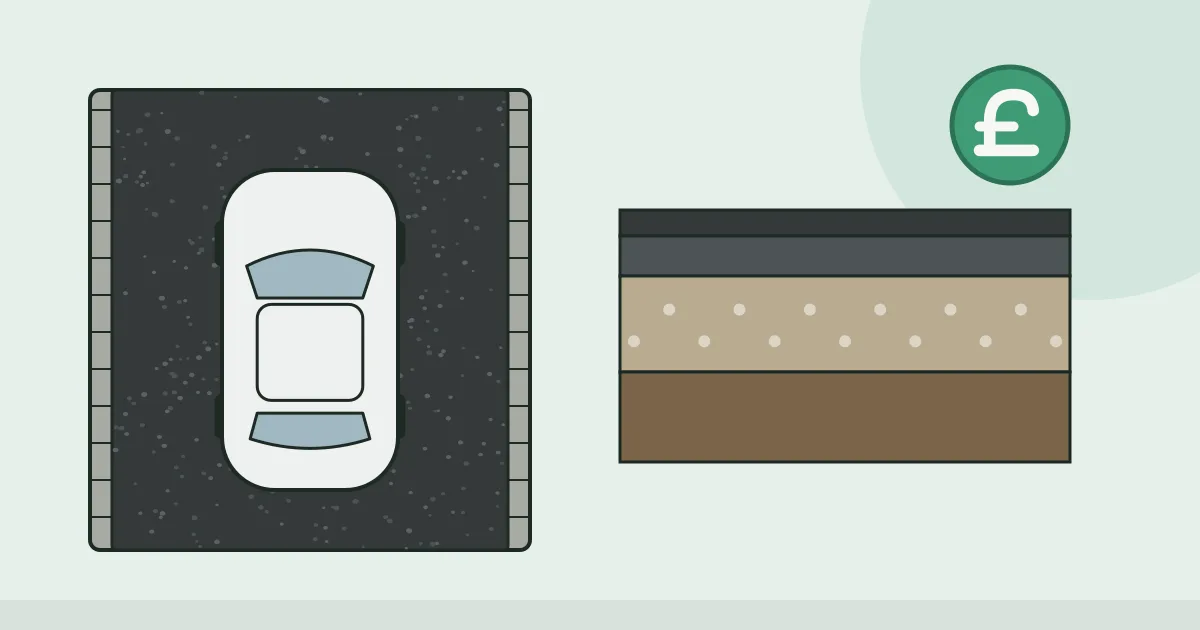
Most new asphalt and tarmac driveways in the UK cost between £2,500 and £6,000 fully installed. That figure covers digging out the old surface, building a compacted stone sub-base, fitting edging and laying the hot bituminous surface in one or two courses. It's one of the more affordable ways to surface a driveway for cars, because the material goes down as one continuous layer from a paver or by hand rather than unit by unit. Where your job lands in the range depends much more on what happens below the surface than on the black layer you actually see.
This guide breaks the price down by driveway size, explains which parts of the job cost the money, and covers the extras that are usually quoted separately. If you're still deciding between surfaces, it's worth reading alongside our overview of asphalt and tarmac driveways.
Tarmac driveway prices by size
Typical UK installed prices for a new asphalt or tarmac driveway, including excavation, sub-base, edging and surfacing. Regional labour rates and ground conditions move these figures.
| Driveway size | Typical scope | Typical cost |
|---|---|---|
| Small (single car) | Roughly one car's width and length, reasonable machine access, old surface removed and a standard sub-base | £2,500 – £3,800 |
| Medium (two cars) | Space for two cars side by side or nose to tail, new edging along both sides, falls set to drain away from the house | £3,800 – £5,000 |
| Large or full width | The whole frontage surfaced, deeper excavation or soft ground, extra drainage, awkward shapes or turning space | £5,000 – £6,000+ |
Those bands match the figures on our asphalt and tarmac driveway page. Treat them as a starting point for judging quotes, not a price for your drive. Two driveways of identical size can sit in different bands if one is going onto firm ground with a clear run for the machinery and the other needs a lorry-load of soft clay dug out first.
Where the money goes on a tarmac drive
It's easy to assume the tarmac itself is the main cost. On most domestic jobs it isn't. A rough way to picture a quote is in four parts:
- Breaking out and carting away. Removing old concrete, slabs or turf and getting the spoil off site is charged by the volume that comes out. A cracked concrete drive being replaced generates far more waste, and more cost, than a lawn being turned into parking.
- The sub-base. Crushed stone is laid and compacted in layers to a depth that suits your ground. The site survey on our tarmac page describes the contractor confirming this depth for your ground conditions, and it's the single part of the job that most decides whether the drive is still flat in fifteen years.
- Edging. Tarmac has no strength at an unsupported edge, so it has to be held by kerbs, a row of block paving setts or similar, usually bedded in concrete. On a long, narrow drive the edging can be a surprisingly large share of the price.
- The surfacing. Dense bitumen macadam laid as a base course and a finer top course, then rolled while hot. A more premium open-textured or stone mastic asphalt, or a red rather than black finish, costs more per square metre.
Once the tarmac is down, nobody can see how deep the sub-base went or how well it was compacted. Ask every contractor to state the excavation depth and sub-base thickness in writing on the quote. A price that's noticeably lower than the others often turns out to be a thinner sub-base, and that's the saving that shows up years later as sinking and potholes.
Costs that often sit outside the headline figure
- A dropped kerb. If the new drive needs vehicle access across a pavement, the kerb has to be lowered with the council's permission. It's a separate application and a separate cost, not included in the ranges above, and fees vary between councils. The gov.uk dropped kerb page routes you to your own council.
- Drainage. Tarmac is impermeable. If the design sends water towards the road, you may need a channel drain or soakaway, or planning permission (see below).
- Manhole and gully covers. Raising or resetting inspection covers to the new finished level is common and is usually priced per cover.
- Making good. Reinstating lawn edges, walls or gate posts disturbed by the work is not always included. Check.
How planning rules can change the price
In England, laying more than 5 square metres of new impermeable surface in a front garden, where the water runs onto the pavement or road, needs planning permission. Tarmac is impermeable, so a front drive either needs designing to drain into your own garden or a soakaway, or needs an application. The drainage route is normally the cheaper of the two, and it's the reason some tarmac quotes include a channel drain that others don't. The gov.uk guidance on paving a front garden sets out the rule. Scotland, Wales and Northern Ireland have their own rules, so check with your local planning authority there.
Is tarmac the cheapest option for your drive?
For a driveway that carries cars every day, tarmac usually comes in below block paving and resin bound for the same area, and in a similar band to plain concrete. Gravel is normally cheaper still, though it asks more of you in upkeep. Our guide to the types of driveway puts all six surfaces side by side, and the driveway surface cost calculator gives a quick ballpark for each one at your size.
One more route is worth knowing about. If you already have a tarmac drive that's structurally sound but tired-looking, a resin bound surface can often be laid straight over it instead of digging it all out. Whether yours qualifies depends on what's failing, and our checklist of signs you need a new driveway helps you tell a worn surface from a failed base.
Frequently asked questions
How much does a tarmac driveway cost per square metre?
It varies too much with access, ground and edging to give one reliable rate, which is why most contractors price the whole job rather than per square metre. As a guide, a single-car drive typically comes in at £2,500–£3,800 and a two-car drive at £3,800–£5,000. Smaller drives usually work out dearer per square metre, because the set-up, machinery and waste costs don't shrink with the area.
Is asphalt the same as tarmac?
On a domestic driveway the words are used almost interchangeably. Strictly, tarmac describes a bitumen-bound stone mix of the kind most drives use, while asphalt usually refers to denser or finer mixes such as stone mastic asphalt. Both are laid hot and rolled. Ask the contractor what mix and thickness they're quoting for, rather than relying on the name.
Can I save money by laying tarmac over my old driveway?
Sometimes, but only if the existing surface is sound, well drained and at a level where adding thickness won't bring the drive up against the house's damp-proof course or the door thresholds. Overlaying a drive that's cracking because its base has failed simply moves the problem up a layer. A reputable contractor will tell you which situation you're in after looking at it.
How long will a new tarmac driveway last?
A well-installed tarmac driveway typically lasts 15–20 years before it needs resurfacing. Sub-base quality, drainage and how much weight the drive carries matter more to that figure than the surfacing itself.
Ready to talk to an asphalt/tarmac driveways specialist?
Get Free Quotes →