
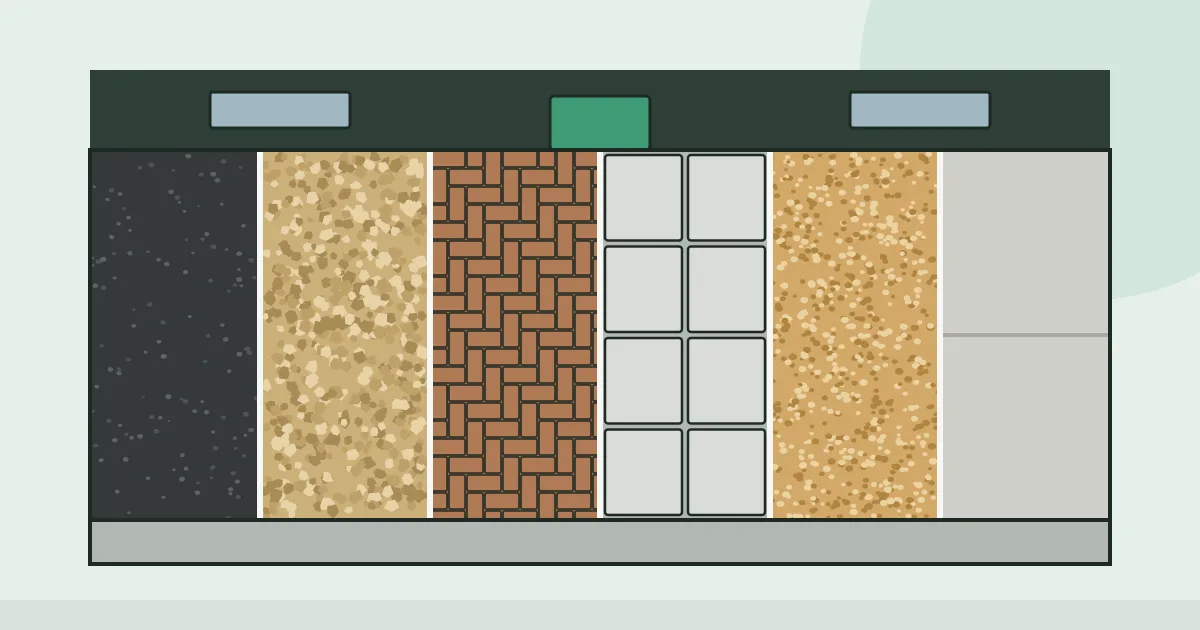
There are six common ways to surface a driveway in the UK: tarmac, gravel, block paving, slab paving, resin bound and concrete. All six can carry a car for decades if they're laid properly. All six go on top of broadly the same thing: an excavated area filled with compacted crushed stone. The differences are in price, how the surface handles rainwater, how it wears and what it asks of you afterwards.
This guide compares them in one place. Start with the table, then read the sections for the two or three surfaces that fit your budget.
The six surfaces at a glance
Typical UK installed prices and timings from our service pages. Lifespans are typical figures for a well-installed drive and depend heavily on the sub-base and drainage. 'Permeable' refers to the planning position for front gardens in England.
| Surface | Typical cost | Install time | Typical lifespan | Permeable? | Main upkeep |
|---|---|---|---|---|---|
| Gravel | £1,200 – £4,000 | 1–3 days | 15–20 years with a grid | Yes | Topping up every 3–5 years, raking |
| Concrete | £2,000 – £5,500 | 2–4 days | 25–30 years | No, unless designed to drain | Occasional clean, resealing if stamped |
| Slab paving | £2,000 – £6,000 | 2–5 days | 20+ years | Usually no with mortar joints | Pointing, sealing some natural stone |
| Tarmac | £2,500 – £6,000 | 2–4 days | 15–20 years | No | Keeping edges sound, clearing spills |
| Block paving | £3,000 – £7,000 | 3–5 days | 20–25 years | Standard no, permeable blocks yes | Re-sanding joints, weeds |
| Resin bound | £3,500 – £8,000 | 2–4 days | Depends mostly on the base | Yes, if the base drains | Keeping the surface clear so it drains |
How the surfaces rank on disruption and complexity
Price isn't the only thing that differs. For each surface we give a relative 1–5 rating to what the job is like to live through. These are our own relative scores based on how each job typically runs, not measured data, but they're a useful way to see the trade-offs:
Relative ratings, 1 (lowest) to 5 (highest). Our own comparison between the six surfaces, not a technical standard.
| Surface | Cost | Complexity | Duration | Dust | Disturbance |
|---|---|---|---|---|---|
| Gravel | 1 | 2 | 1 | 2 | 1 |
| Concrete | 2 | 3 | 3 | 3 | 3 |
| Tarmac | 3 | 3 | 3 | 2 | 3 |
| Slab paving | 3 | 3 | 4 | 3 | 3 |
| Block paving | 4 | 4 | 5 | 3 | 4 |
| Resin bound | 5 | 3 | 3 | 2 | 3 |
Block paving scores highest for duration and disturbance because every unit is laid and many are cut by hand. Gravel is the quickest and least disruptive, with no hot materials, no curing and no cutting.
Tarmac: the practical all-rounder
Tarmac is laid hot as a continuous surface and rolled, so it's quick to install and ready to drive on within a couple of days. It copes well with daily traffic, costs less than block paving or resin, and is easy to live with. Its drawbacks are that it looks plain, can soften in very hot weather, and doesn't drain through. That means planning and drainage have to be thought about on a front drive. It suits a busy family drive where durability and price matter more than looks. See the tarmac driveway cost guide.
Gravel: cheapest, permeable, needs looking after
Gravel is the cheapest surface to install and one of the few that's naturally permeable without extra work. It also suits rural and period properties, where a bound surface can look out of place. The trade-offs are ruts and scattered stone, which a stabilisation grid largely solves, plus the crunch underfoot, weeds if the membrane fails, and the need for top-ups. It's hard work for wheelchairs, buggies and wheelie bins. See the gravel driveway cost guide.
Block paving: repairable and decorative
Block paving offers the widest range of looks through colour, pattern and borders. Its real practical advantage is that a sunken or damaged area can be lifted and relaid without touching the rest of the drive. It's labour-heavy, so it costs more and takes longer. Standard block paving is impermeable, but permeable blocks are available. The joints need occasional re-sanding and weeding. See the block paving cost guide.
Slab paving: clean lines, careful build
Slabs of concrete, natural stone or porcelain give a more contemporary, open look than blocks, and they're the natural choice where a drive runs into a patio. Laid for vehicles, they need a deeper sub-base and full bedding. Many slabs are only designed for foot traffic, so the specification matters more than with any other surface. See the slab paving cost guide.
Resin bound: smooth, permeable, depends on its base
Resin bound mixes natural stone with clear resin into a smooth, seamless and porous finish that doesn't shed stones. It's permeable, which helps with planning, and it can often be laid over a sound existing tarmac or concrete drive. That makes it an upgrade path as well as a new-build option. The catch is that it's only as good as the base underneath, and on a new base it's the most expensive of the six. Don't confuse it with resin bonded, a cheaper product that scatters loose stone onto a resin coat. See the resin bound cost guide.
Concrete: long-lived and good value
A reinforced concrete slab typically lasts 25–30 years, the longest of the six, and plain or brushed concrete is good value. Stamped and exposed-aggregate finishes add decoration at extra cost. Its weakness is cracking where the slab is too thin, the reinforcement is missing or the ground moves. Well-cut control joints keep cracking in straight, tidy lines. See the concrete driveway cost guide.
Three questions that narrow it down
- Is it a front garden, and where will the water go? In England, more than 5 square metres of impermeable surface in a front garden draining onto the road needs planning permission. Gravel, resin bound and permeable block paving generally avoid it. Tarmac, concrete, standard blocks and most mortar-jointed slabs need designing to drain into your own garden or a soakaway. The gov.uk guidance on paving a front garden explains the rule. Scotland, Wales and Northern Ireland set their own, so check with your council there.
- Is there an existing drive worth keeping as a base? If a tarmac or concrete drive is sound but tired, resin bound over the top can cost less than digging out and starting again. Our checklist of signs you need a new driveway helps you judge that.
- What will the drive need to do in ten years? If you're planning to charge an electric car at home, the cable route is far easier to put in before the surface goes down. Our guide to getting your driveway ready for an electric car covers it.
Whichever surface you choose, the compacted stone sub-base beneath it does most of the structural work. A premium surface on a thin sub-base will fail before a budget surface on a good one. Ask every contractor to put the excavation depth and sub-base specification in writing.
When you've narrowed it to two or three, the driveway surface cost calculator shows each one at your size, and a local contractor can quote the ones that suit your ground.
Frequently asked questions
What is the most popular type of driveway in the UK?
Tarmac and block paving are the most familiar driveway surfaces on UK streets, with gravel common on rural and older properties. Resin bound has become a popular upgrade over the last decade, particularly where an existing tarmac or concrete drive can be used as the base.
What is the longest-lasting driveway surface?
A properly reinforced concrete driveway typically lasts 25–30 years, and block paving typically 20–25 years. In practice the sub-base and drainage decide lifespan more than the surface does, so a well-built drive in any material will outlast a poorly built one in the 'best' material.
Which driveway needs the least maintenance?
Resin bound, plain concrete and tarmac need the least day-to-day upkeep, mostly just clearing debris and dealing with spills. Block paving needs its joints re-sanded and weeded from time to time, and gravel needs raking and topping up every three to five years.
Which driveway surfaces don't need planning permission?
In England, permeable surfaces, including gravel, resin bound on a draining base and permeable block paving, are generally exempt from the front-garden rule. Impermeable surfaces also avoid it if they're under 5 square metres or drain into your own garden or a soakaway. Listed buildings and conservation areas can have extra restrictions, and a dropped kerb always needs separate council consent.
Ready to talk to an asphalt/tarmac driveways specialist?
Get Free Quotes →