
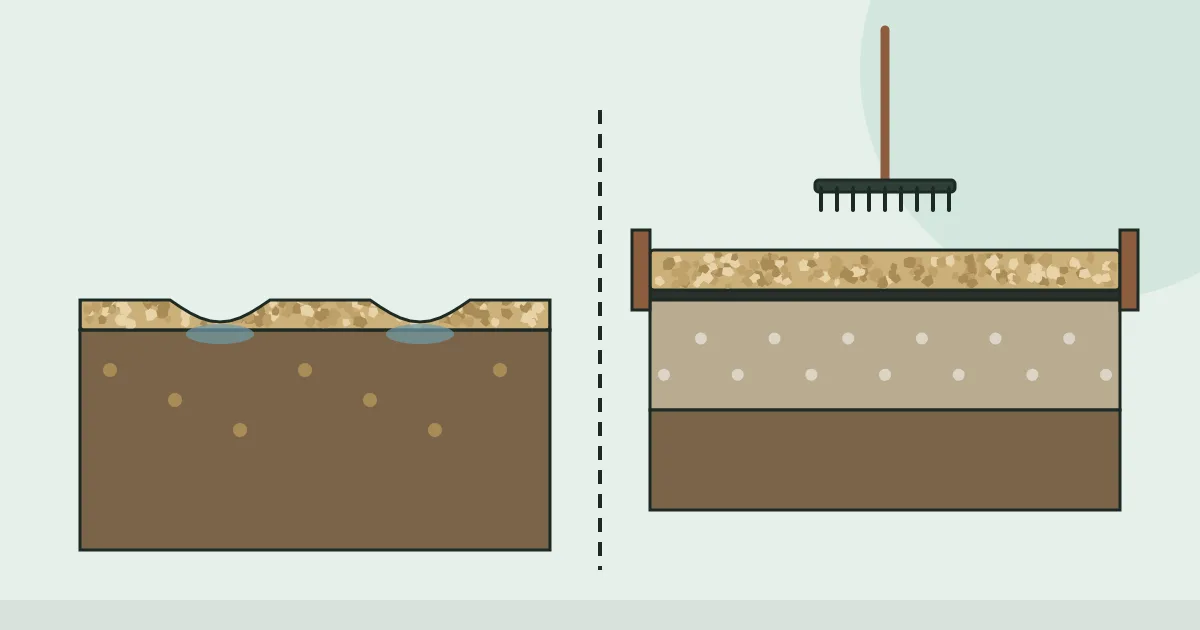
Gravel is the one driveway surface on our site that a capable homeowner can reasonably lay themselves. There's no hot tarmac to roll, no concrete to finish before it sets, and no blocks to cut to a pattern. Spreading and raking stone is easy. Everything that happens before the stone arrives is hard, and that's where DIY gravel drives tend to go wrong.
Below is an honest split of the work: what's realistic to do yourself, where a professional earns their fee, and how to tell which side of the line your drive sits on.
Who should seriously consider DIY
- The drive is small, roughly one car's worth, and fairly flat.
- The ground is firm and drains well. A spade goes in without the hole filling with water.
- You can get a skip or grab lorry in to take away the spoil, and a bulk bag or lorry load of stone delivered close to the work.
- You're happy to hire and use a plate compactor, and have help for a couple of heavy days.
- No dropped kerb is needed, or you'll arrange that separately through the council.
If most of that doesn't describe your drive, our gravel driveway cost guide shows what a professional install typically costs, starting at around £1,200 for one car. Labour is a real share of that, but so is the groundwork you'd still need to do or hire in.
Task by task: DIY or professional?
The stages of a gravel driveway, how realistic each is as DIY, and what most often goes wrong.
| Stage | Realistic as DIY? | Where it goes wrong |
|---|---|---|
| Marking out and levels | Yes, with string lines and a level | No fall set, so water sits in the middle or runs to the house |
| Excavation | Hard work on anything but a small drive; a mini digger helps | Dug too shallow or unevenly; topsoil left in |
| Removing spoil | Needs a skip or grab lorry | Far more spoil than expected once it's loosened |
| Edging | Yes for timber boards; harder for kerbs set in concrete | Edging left out, or boards with no pegs, so stone spreads |
| Sub-base and compaction | Possible with a hired plate, done in layers | Stone tipped to full depth and compacted once; soft bottom layer |
| Membrane | Yes | Torn while spreading stone, or laid on soil instead of on the sub-base |
| Stabilisation grid | Possible, but fiddly to level and clip | Laid on an uneven base, so cells tilt and stone migrates |
| Spreading gravel | Yes | Too deep, so it's loose and hard to walk or drive on |
The warning signs listed on our gravel driveways page match the right-hand column almost exactly: ruts, migrating stone, weeds through a torn membrane, and standing water from a weak or missing sub-base. None of them start with the gravel.
Why the sub-base decides it
A gravel drive gets its strength from the compacted stone underneath, not from the decorative layer you see. Most DIY failures come down to that layer being too thin or not properly compacted. The rule that catches people out is layers: a plate compactor only consolidates a limited depth at a time, so the sub-base has to go down and be compacted in stages. Our guide to the driveway sub-base covers typical depths and how to check them.
Some homeowners pay a groundworker to dig out, lay the sub-base and fit edging, then spread the membrane, grid and gravel themselves. You keep the easy, visible part and hand over the part that decides whether the drive lasts. Not every contractor will quote for groundwork only, but plenty will if you ask.
Getting the stone right
Gravel for a drive is not the same as gravel for a border. Angular chippings lock together under tyres; rounded pea shingle rolls and ruts. Finished depth matters too. The decorative layer is typically around 30–50mm, and going deeper makes it loose rather than stronger. Our comparison of driveway gravel types covers stone shapes, sizes and when a grid is worth it.
Hidden costs of doing it yourself
- Spoil removal. Digging out even a small drive produces several tonnes of soil and old surface, and it bulks up once loosened.
- Hire. A plate compactor and possibly a mini digger, plus delivery and fuel.
- Materials bought at retail rather than trade prices, and delivery charges for heavy bulk bags.
- Your time. A professional crew usually lays a gravel drive in one to three days; DIY often stretches over several weekends.
- Fixing it later. If the drive ruts or sinks, putting it right usually means taking the gravel up and redoing the sub-base.
How to lay a small gravel driveway
- Mark out and set the fall
Peg out the area with string lines and set a gentle fall away from the house towards a lawn, border or drain, so rainwater doesn't sit on the drive.
- Excavate
Dig out the old surface, topsoil and roots to a consistent depth that allows for the sub-base and gravel, following the fall you set.
- Fit the edging
Install timber boards on pegs, or kerbs bedded and haunched in concrete, around every open side to hold the stone in.
- Lay and compact the sub-base in layers
Spread crushed stone sub-base in layers of roughly 100mm or so and compact each one with a plate compactor before adding the next.
- Lay the membrane and grid
Roll out a weed membrane over the compacted sub-base with generous overlaps, then lay and clip together a stabilisation grid on top if you're using one.
- Spread the gravel
Fill the grid or spread the stone until it's roughly 30–50mm deep, rake it level and run the compactor over it lightly if the supplier recommends it.
Frequently asked questions
Can I lay gravel straight onto soil?
Not for a driveway. Gravel spread on soil sinks in, mixes with the mud and ruts under tyres within months. It needs a compacted stone sub-base and usually a membrane underneath.
Do I need a plate compactor for a gravel driveway?
Yes, for the sub-base. Treading it down or rolling it with a garden roller won't consolidate crushed stone enough to carry a car. Plate compactors can be hired by the day.
Is it worth putting a grid under a DIY gravel drive?
On a drive used every day, usually yes, because it stops rutting and stone migration. Grids need a flat, well-compacted base to sit on, though, so they don't fix a poor sub-base.
Do I need permission to lay a gravel drive myself?
In England a front drive in free-draining gravel generally doesn't need planning permission, because the water soaks through. If you'll be driving across a pavement, you still need the council's consent for a dropped kerb, whoever lays the drive.
Ready to talk to a gravel driveways specialist?
Get Free Quotes →