
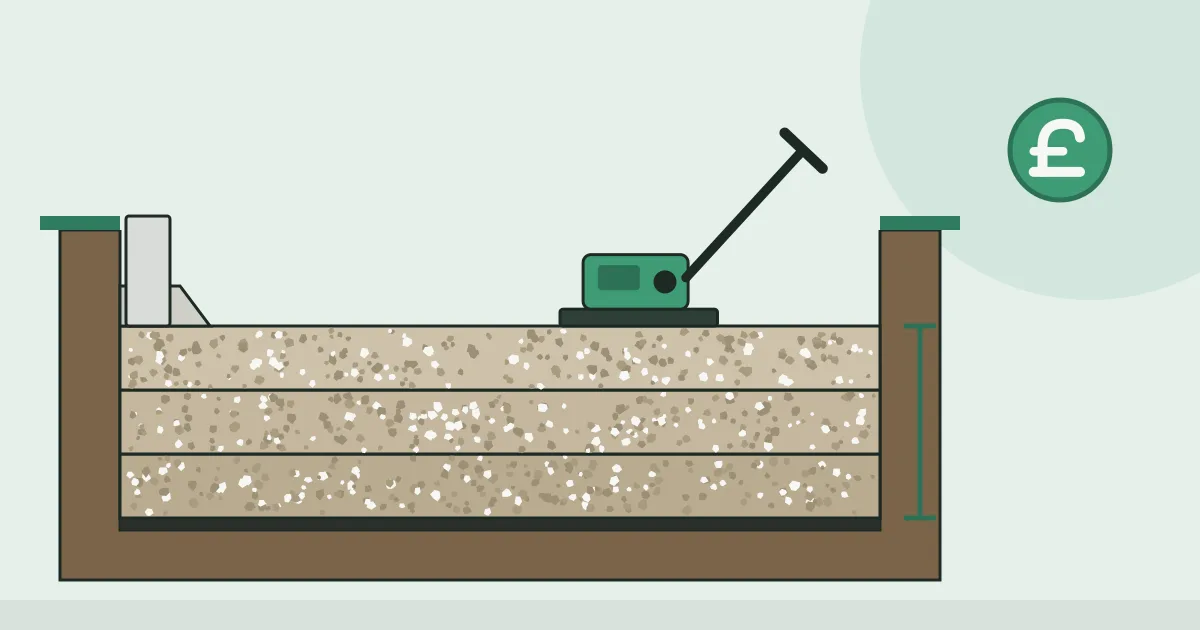
Every driveway surface we cover, from tarmac to slabs, sits on the same thing: a layer of crushed stone, compacted hard, that you never see once the job is finished. It's the part of the build that carries the car. The surface on top mostly decides how the drive looks and how it drains. The sub-base decides whether it stays flat.
Because it's buried on day one, the sub-base is also the easiest place to save money on a quote without the customer noticing. This guide explains what a sound one looks like, how deep it usually goes, and how to read a failing drive back to the layer that caused it.
What's under a driveway, from the soil up
- The formation. This is the natural ground at the bottom of the dig, once topsoil, roots and soft spots have been removed. Topsoil compresses and rots, so it should never stay under a drive.
- A geotextile membrane, where needed. On soft or clay ground a membrane stops the stone being pushed down into the soil and the soil working up into the stone. On firm ground it isn't always used.
- The sub-base. Usually a graded crushed stone known as Type 1, with pieces from about 40mm down to dust. The mix of sizes is the point: the fines fill the gaps between the larger stones, so it compacts into a dense, interlocking layer.
- A bedding or binder layer. What goes here depends on the surface: sharp sand under block paving, a mortar bed under slabs, a binder course under tarmac. Concrete is poured directly onto the sub-base, and gravel sits on a membrane or grid on top of it.
- The surface. The part you chose and the part you'll look at for the next couple of decades.
Permeable drives work slightly differently. They use a cleaner, open-graded stone with the fines left out, so water can pass through and be stored in the voids. A permeable drive built on standard Type 1 won't drain as designed. Our guide to permeable and impermeable driveways explains why that matters for planning.
How deep should a driveway sub-base be?
There's no single right answer, and a contractor who gives one figure for every site without looking at the ground is guessing. The depth depends on what the soil can bear and what will drive on it. As a broad guide:
Typical compacted sub-base depths for domestic work. These are ranges, not a specification; the right depth for your drive depends on the ground the contractor finds when they dig.
| Situation | Typical compacted sub-base | Why it varies |
|---|---|---|
| Patio or path, foot traffic only | Around 100–150mm | Firm ground at the lower end; softer ground needs more |
| Car driveway on firm, well-drained ground | Around 150–200mm | Daily car use; heavier vehicles or tight turning need the top of the range |
| Car driveway on clay or soft ground | Around 200–300mm, often with a membrane | Soft ground spreads load poorly and moves with the seasons |
| Occasional heavy vehicles (vans, delivery lorries, a motorhome) | Deeper again, designed for the load | Worth asking for a design rather than a rule of thumb |
On top of the sub-base comes the bedding and surface, so the total dig for a block paved or tarmac drive is deeper than these figures. That's why excavation and spoil removal are such a large share of the cost, and why our asphalt and tarmac cost guide puts groundwork at the heart of the price.
Compaction: the step nobody photographs
Loose stone isn't a sub-base. It becomes one when it's compacted, and it has to be compacted in layers. A vibrating plate or roller can only consolidate a limited depth at a time, typically around 100mm or so per pass for a plate compactor. Tipping 200mm of stone in one go and running a plate over the top leaves a hard crust over a loose bottom half. That bottom half settles later, under your car.
Moisture matters too. Type 1 compacts best slightly damp. Bone dry, it won't bind; waterlogged, it pumps and moves. A good installer will damp it down in a dry spell and won't compact in standing water.
Falls and edges are part of the sub-base too
The sub-base is where the drive's fall is set. If the stone is laid flat and the surface is shaped to fall on top of it, the bedding ends up uneven in thickness and the thin spots fail first. The slope that sends water away from the house, often somewhere around 1 in 60 to 1 in 80, should be built into the sub-base itself.
Edges hold the whole thing together. Block paving, gravel and tarmac all spread sideways under load if nothing stops them. A kerb or edging course bedded on concrete, sitting on the sub-base, is what stops the outer rows of blocks creeping and the tarmac edge crumbling. On a gravel drive the edging also keeps the stone where it belongs.
Reading failures back to the sub-base
Most of the warning signs in our checklist of signs you need a new driveway look like surface problems but start lower down:
Common driveway failures and the sub-base fault usually behind them.
| What you see | Surface | Usual cause underneath |
|---|---|---|
| Potholes and crazed cracking spreading from one area | Tarmac | Thin or poorly compacted sub-base, or water sitting in it |
| Blocks sinking in the wheel tracks | Block paving | Sub-base too shallow for car loads, or not compacted in layers |
| Outer rows of blocks spreading or tilting | Block paving | Missing or weak edge restraint |
| Ruts and bald patches that come back after raking | Gravel | Soft or missing sub-base under the membrane |
| Wide cracks with one side lower than the other | Concrete | Settlement of a poorly compacted or soft base, sometimes near trees on clay |
| Rocking slabs and cracked pointing | Slabs | A patio-depth build carrying car loads |
This is why a sunken patch on a drive that's otherwise fine can often be lifted, re-based and relaid, but a drive that's sinking all over usually can't be saved by resurfacing. New tarmac or resin on a moving base inherits the movement.
"We always do a proper sub-base" isn't a specification. A quote should give the compacted depth of sub-base, the material (for example Type 1), whether a membrane is included and what edging will be used. If two quotes differ a lot in price, this is the first place to compare them. Our guide to comparing driveway quotes goes through the rest of the list.
How to check a driveway sub-base while it's being built
- Look at the bottom of the dig
Before any stone goes in, check that topsoil, roots and soft spots have gone and the formation is firm. Ask the contractor if the ground is what they expected.
- Ask about the membrane
On clay or soft ground, ask whether a geotextile membrane is going down before the stone. If not, ask why not.
- Watch the stone go down in layers
The sub-base should be spread and compacted in layers of roughly 100mm or so, not tipped to full depth and compacted once.
- Measure the compacted depth
Once the sub-base is finished, a tape measure against the edge of the dig or a string line shows its depth. Compare it with the figure on the quote.
- Check the fall
The sub-base should already slope away from the house and towards the drainage point. A spirit level or a bucket of water poured on the stone shows which way it runs.
- See the edging set before the surface
Kerbs or edging should be bedded and haunched in concrete before the bedding and surface go down, so they can restrain it.
Frequently asked questions
What is Type 1 sub-base?
Type 1 is a graded crushed stone, usually limestone or granite, with pieces from around 40mm down to dust. The range of sizes lets it compact into a dense, load-bearing layer. It is the standard sub-base for most impermeable domestic drives.
Can you lay a new driveway on top of an old one?
Sometimes. A sound, well-drained old drive can act as the base for an overlay such as resin bound or a new tarmac surface course. If the old drive is sinking or cracking from below, its base has failed and it needs digging out, because a new surface will follow the same movement.
Why does sub-base depth vary so much between quotes?
Partly because ground conditions differ, and partly because the sub-base is buried and hard to check later, which makes it an easy place to cut cost. Ask every contractor to state the compacted depth and material in writing so you can compare like with like.
Is crushed concrete OK as a driveway sub-base?
Recycled crushed concrete graded to a similar specification is widely used and can perform well. What matters is that it is properly graded, free of rubbish such as plaster, wood and plastic, and compacted in layers like any other sub-base.
Ready to talk to an asphalt/tarmac driveways specialist?
Get Free Quotes →