
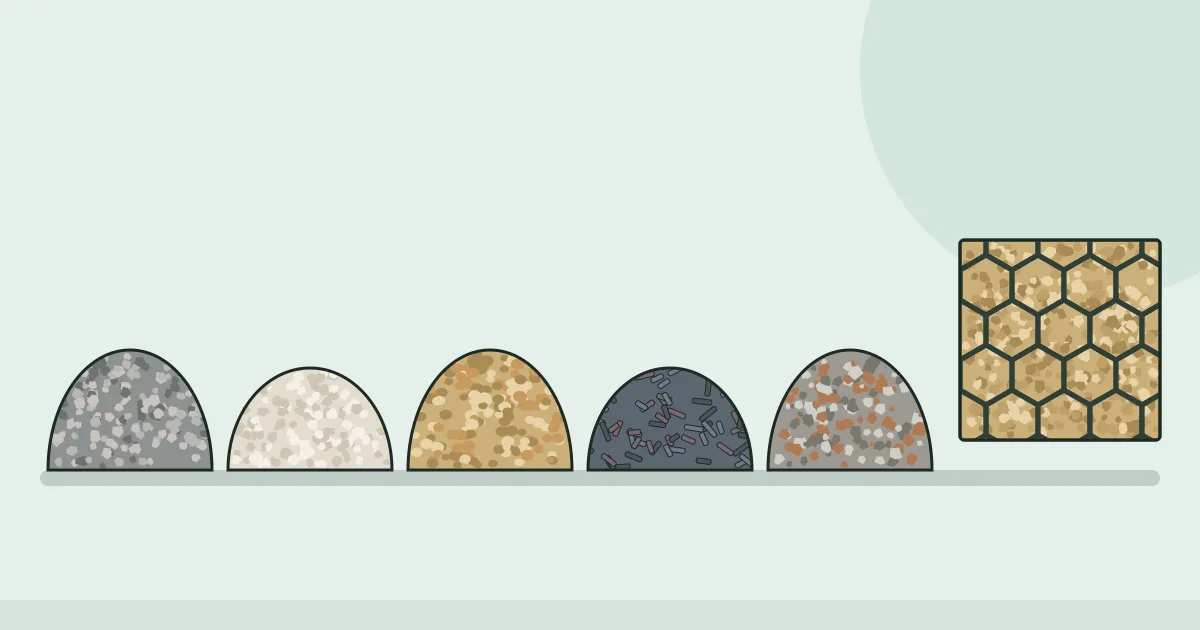
This guide compares the main categories of stone sold for gravel driveways by shape, hardness and size. We don't name suppliers or quarries and we don't claim one grid system outperforms another. Colour and quality vary even within one type, so ask for a sample before ordering.
The best gravel for a driveway is the one that stays where you put it. Under tyres, stone gets pushed, rolled and ground against itself. Shape matters more than colour: angular stones lock together and resist movement, while rounded stones roll like ball bearings. Size and hardness come next. Colour, the thing most people choose on, comes last for performance, though it obviously matters for how the drive looks.
Common driveway stones compared
Driveway gravel types compared by shape, hardness and how they behave under cars. Relative price varies by region and delivery distance.
| Stone | Shape | Under cars | Watch out for | Relative price |
|---|---|---|---|---|
| Granite chippings | Angular | Locks together well; very hard and durable | Can be sharp underfoot; fewer warm colours | Mid to high |
| Limestone chippings | Angular | Locks together well | Softer, so can break down and get dusty; pale stone shows dirt | Low to mid |
| Pea shingle | Rounded | Rolls and ruts, especially where cars turn | Spreads onto lawns and pavements; poor on slopes | Low |
| Slate chippings | Flat | Can break up under regular car use | Sharp edges, noisy, better for light use | Mid |
| Recycled crushed aggregate | Angular | Locks together; good as a base layer | Less decorative; quality and cleanliness vary | Low |
Angular chippings: the usual choice
Crushed stone has broken, sharp-edged faces that wedge against each other when compacted. That's why angular chippings rut less, stay level longer and climb less onto the lawn. Granite is the hardest and lasts best under daily car use. Limestone is cheaper in many areas and locks together just as well, but it's softer, so it can wear and crush over time and white limestone shows tyre marks and dirt. Many decorative "golden" and buff gravels are also crushed stone and behave the same way.
Pea shingle: cheap, pretty and restless
Pea shingle is naturally rounded, often dredged or quarried flint. It's comfortable to walk on, looks soft and is usually among the cheapest options, which is why it's so common. On a drive, though, its round shape means it never really locks. Tyres push it into ridges, turning cars dig holes in it, and it travels. It can work in a stabilisation grid, which holds the stones in cells, but on its own it's better suited to paths and borders than daily parking.
Slate and recycled stone
Slate chippings come in plum, blue and green and look striking, but the flat shards don't lock well and can snap under the weight of a car. They suit lightly used drives and decorative areas more than a main parking space. Recycled crushed concrete and brick is cheap and sensible as a sub-base or for a rough farm track; as a top surface it's less decorative and quality varies, so check it's clean and free of plaster, wood and plastic.
Which size?
- Around 10mm. Easier to walk on, but small stones get picked up in tyre treads and shoe soles, kicked around and shift more readily.
- Around 14–20mm. The range most often recommended for driveways. Big enough to stay put under tyres, small enough to walk on comfortably.
- Larger than 20mm. Stable but hard work for walking, wheelie bins and buggies, and noisier.
The finished layer is usually around 30–50mm deep. More stone doesn't make the drive stronger; it makes it loose. The strength comes from the compacted sub-base underneath, which is covered in our guide to laying a gravel driveway yourself vs hiring a professional.
Loose gravel or a grid?
This is a separate decision from stone type, and on a drive used every day it often makes more difference. A stabilisation grid is a honeycomb of plastic cells laid on the sub-base and filled with stone. The cells stop the stone moving sideways, so ruts, bald patches and migration are much reduced, and it can make even rounded stone workable. Grids add to the cost, which is why a large drive with a grid throughout sits in the top band of our gravel driveway cost guide.
Loose gravel over a membrane is cheaper and fine on a lightly used or short drive with angular stone. Loose or gridded, gravel stays permeable as long as the base beneath it drains, which is one of the main reasons people choose it; our guide to permeable vs impermeable driveways explains the planning side, and our gravel driveways page covers the install.
Frequently asked questions
What is the best size gravel for a driveway?
Angular stone of around 14–20mm is the size most often recommended for driveways. It's large enough to stay in place under tyres and small enough to walk on. Smaller stone shifts and gets carried off on tyres and shoes.
Is pea gravel good for a driveway?
Not on its own. Pea shingle is rounded, so it rolls and ruts under tyres and spreads onto lawns and pavements. It works better in a stabilisation grid, or on paths and borders.
How deep should driveway gravel be?
The decorative layer is usually around 30–50mm. Deeper than that and it becomes loose and hard to walk or drive on. The load-bearing depth comes from the compacted sub-base underneath.
Does gravel colour affect how it performs?
Not directly. Shape, hardness and size matter more. Colour does affect how dirt, oil marks and leaves show, and pale stones such as white limestone tend to look grubby sooner.
Ready to talk to a gravel driveways specialist?
Get Free Quotes →