
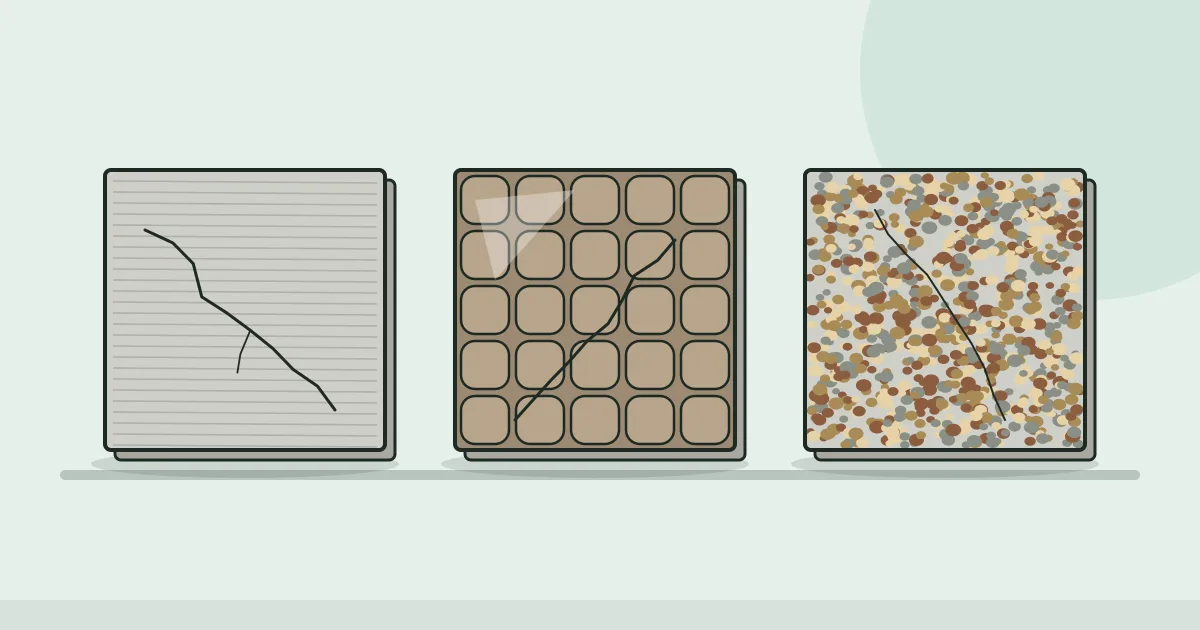
This comparison covers the three common finishes for a concrete driveway. It isn't a ranking of installers or products, and we haven't tested any finish ourselves. The cost bands come from our concrete driveways page. How a finish performs depends a great deal on the slab beneath it and the person laying it.
The finish is the last thing that happens to a concrete drive, minutes or hours after the pour, while the surface is still workable. It decides how the drive looks, how much grip it has when wet, how much upkeep it needs and how obvious a crack will be. It doesn't decide how strong the drive is. That comes from the sub-base, slab thickness and reinforcement, which is why our concrete driveway cost guide treats them separately.
The three finishes side by side
Plain or brushed, stamped and exposed-aggregate concrete compared. Price bands are from our concrete driveways page.
| Plain or brushed | Stamped (imprinted) | Exposed aggregate | |
|---|---|---|---|
| Typical cost band | £2,000 – £4,400 depending on size | Usually £4,400 – £5,500+ | Usually £4,400 – £5,500+ |
| Look | Plain grey with a fine broom texture | Pattern and colour imitating blocks, setts or stone | Natural stones visible at the surface |
| Grip when wet | Good, from the brushed texture | Can be slippery once sealed unless an anti-slip additive is used | Good, from the textured surface |
| Sealing | Rarely needed | Sealed when laid; resealing every few years | Sometimes sealed to deepen colour |
| How cracks show | Clearly, as a line across plain grey | Through the pattern; colour hard to match in a repair | Less obvious against the texture |
| Repairs | Simple patches, though new concrete looks different at first | Hard to repair invisibly | Patches can show a different stone mix |
Plain or brushed
Plain concrete is levelled and floated, then drawn over with a stiff broom while it's still soft, leaving fine parallel ridges. The texture gives grip in wet weather and frost. It's the cheapest finish, the quickest to lay and needs almost nothing after laying. It's also the most utilitarian look, and a crack in plain grey concrete is easy to see. Control joints, cut in straight lines, are there to give cracking somewhere tidy to happen.
Stamped or imprinted
Stamped concrete is coloured, usually with a surface hardener or dry-shake colour, then pressed with rubber mats while still workable to create a pattern: cobbles, blocks, slate, flagstones. A release agent adds a second tone, and the whole surface is sealed. The appeal is the look of paving without thousands of joints for weeds and sand loss.
The sealer is what needs looking after. It wears in wheel tracks and fades in strong sun, and resealing every few years keeps the colour and protection. Sealed concrete can be slippery when wet, so ask whether an anti-slip additive will be included. Repairs are the weak point: matching both the pattern and the weathered colour of a ten-year-old drive is very difficult. Stamped concrete has also had a patchy reputation, largely because of poor installs on thin or unreinforced slabs, so the slab specification matters as much here as anywhere.
Exposed aggregate
Exposed aggregate uses a mix with decorative stone in it. After the pour, the top layer of cement paste is washed or brushed off, or a retarder is used so the surface can be washed back the next day, leaving the stones standing slightly proud. The result is a textured, grippy surface that looks more natural than plain concrete and hides dirt, stains and fine cracks well.
It's more expensive than plain concrete because of the decorative aggregate and the extra step, and the timing has to be right; washing too early loosens stones, too late and they won't show. Over-aggressive pressure washing later can also loosen stones at the surface. Our driveway maintenance guide covers cleaning each finish.
What none of the finishes fixes
- A thin or unreinforced slab. Finish doesn't add strength, so check the thickness and reinforcement on the quote first.
- A poor sub-base. Sinking and wide cracks start below the concrete, whatever's on top.
- Frost and salt in the first winter. Young concrete is most vulnerable to surface scaling, so ask your installer about de-icing salt.
- Planning. Concrete is impermeable whichever finish you pick, so a front drive over 5 square metres in England needs to drain to your own land or have permission.
If you already have a sound concrete drive and want a new look rather than a new slab, resin bound can sometimes go over it instead; our guide to resin over an existing driveway explains when. For the installation process itself, see our concrete driveways page.
Frequently asked questions
Is imprinted concrete a good idea for a driveway?
It can be, provided the slab underneath is properly built and reinforced and you're happy to reseal it every few years. Its weak points are repairs, which are hard to match, and grip when wet if no anti-slip additive is used in the sealer.
Which concrete finish is the least slippery?
Brushed and exposed-aggregate finishes both offer good grip because of their texture. Stamped concrete is smoother and is sealed, so it can be slippery when wet unless an anti-slip additive is mixed into the sealer.
How often does stamped concrete need resealing?
Typically every few years, depending on how much traffic and sun the drive gets. The sealer wears fastest in the wheel tracks. Resealing restores the colour and helps protect the surface.
Can you change the finish on an existing concrete driveway?
Not really, since the finish is formed while the concrete is fresh. A sound existing slab can sometimes be overlaid with resin bound or another surface instead, which gives a new look without breaking out the concrete.
Ready to talk to a concrete driveways specialist?
Get Free Quotes →