
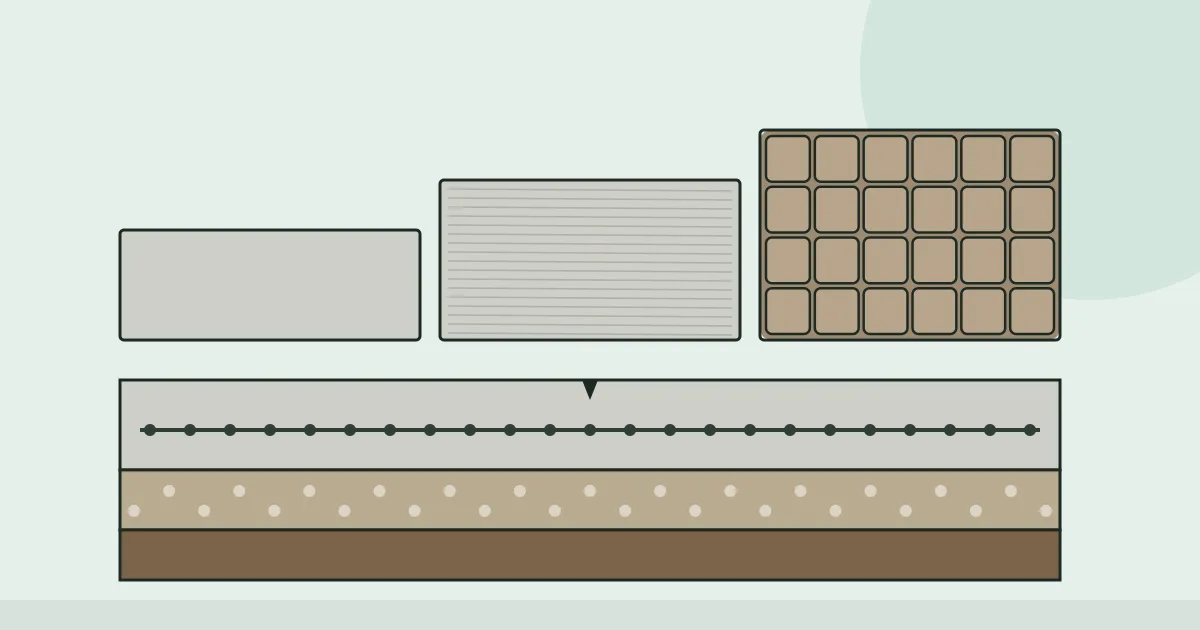
A new concrete driveway in the UK typically costs between £2,000 and £5,500. Two things decide where your job falls: the size of the slab and the finish on top of it. Plain or brushed concrete is one of the most economical ways to build a hard-wearing drive for cars. Stamped and exposed-aggregate finishes use the same slab underneath, with extra work at the surface that takes the price towards the top of the range.
Concrete is also the surface where the parts you can't see matter most. Slab thickness, reinforcement and the sub-base decide whether it lasts 25 years or cracks in its first winter. The process is set out on our concrete driveways page. This guide focuses on the money.
Concrete driveway prices by size and finish
Typical UK installed prices for concrete driveways, including excavation, sub-base, formwork, reinforcement, pouring and finishing. Actual quotes vary with region, access and ground conditions.
| Driveway size / finish | Typical scope | Typical cost |
|---|---|---|
| Small, plain or brushed finish | A single-car slab with a broom finish for grip, straightforward formwork and access for a ready-mix lorry | £2,000 – £3,200 |
| Medium, plain or brushed finish | A two-car slab, more formwork and reinforcement, control joints cut to manage cracking | £3,200 – £4,400 |
| Large, or stamped / exposed aggregate | A full frontage, or any size with a patterned or exposed-aggregate finish that adds skilled finishing time | £4,400 – £5,500+ |
What you're paying for in a concrete slab
- Excavation and sub-base. The ground is dug out and a compacted stone sub-base is laid. On soft or clay ground this has to be deeper, which costs more.
- Formwork. Timber or metal boards shape the edges of the slab while it's poured. Curves and complicated outlines take longer to set up.
- Reinforcement. Steel mesh or fibres mixed into the concrete help it resist cracking under load and ground movement. It's one of the easiest things to leave out of a cheap quote.
- The concrete itself. It's usually delivered ready-mixed. If the lorry can't reach the drive, the concrete may have to be pumped or barrowed, which adds cost.
- Finishing and curing. The surface is levelled and textured, and control joints are cut. The slab then needs time before it takes regular vehicle weight, often around a week depending on the weather.
When comparing concrete quotes, ask each contractor for the slab thickness, the type of reinforcement, where the control joints will go and how deep the sub-base will be. These four lines decide how the drive ages. The finish on top is mostly a matter of looks.
Plain, stamped or exposed aggregate
A brushed finish is a light broom texture applied while the concrete is still workable, and it costs very little on top of the slab. Stamped, or pattern-imprinted, concrete has a pattern pressed into the surface before it sets. It usually has colour added too, so it can imitate block paving, cobbles or stone, and it needs resealing periodically to keep its colour. Exposed aggregate has the top layer of cement washed off to reveal the decorative stone in the mix, giving a textured, grippy finish. Both decorative finishes need skilled work in the short window before the concrete sets. That timing, rather than extra materials, is most of what you pay for.
Planning, drainage and cracking
Poured concrete is impermeable. In England, more than 5 square metres of new concrete in a front garden, draining onto the road, needs planning permission unless the water is directed to your own garden or a soakaway. Some contractors design in channel drainage or permeable strips specifically to avoid this, so ask at quote stage. The gov.uk guidance on paving a front garden has the detail for England, and Scotland, Wales and Northern Ireland set their own rules. Cracking is concrete's best-known weakness. Well-placed control joints guide it into straight, tidy lines, while wide, random cracks usually point to a thin slab, missing reinforcement or ground movement underneath.
How concrete compares
A plain concrete drive usually costs about the same as tarmac and less than block paving. With its typical 25–30 year life, it's one of the longer-lasting options. If you already have a concrete drive that's sound but looks dated, it may make a good base for a resin bound overlay rather than being broken out. Our guide to the types of driveway compares all six surfaces, and the driveway surface cost calculator gives a quick figure for each.
Frequently asked questions
Is a concrete driveway cheaper than tarmac?
They're usually close. A small plain concrete drive typically starts around £2,000 and a small tarmac drive around £2,500, but ground conditions, access and edging can swing either one. Once a decorative stamped or exposed-aggregate finish is added, concrete moves above tarmac.
How thick should a concrete driveway be?
It depends on the ground and the vehicles using it, so it's a question for your contractor rather than a single number. What matters is that the thickness and the reinforcement are stated on the quote. A slab that's too thin for its load is the most common cause of early cracking.
Does stamped concrete need maintenance?
Usually some. Most pattern-imprinted concrete is sealed after installation, and the sealer typically needs renewing every few years to keep the colour and resist staining. Plain and brushed concrete need very little beyond an occasional clean.
How long before I can drive on a new concrete driveway?
It's typically walkable within a few days but not ready for regular vehicle weight for around a week, depending on the weather and the mix. Driving on it too early is one of the easiest ways to crack a new slab.
Ready to talk to a concrete driveways specialist?
Get Free Quotes →