
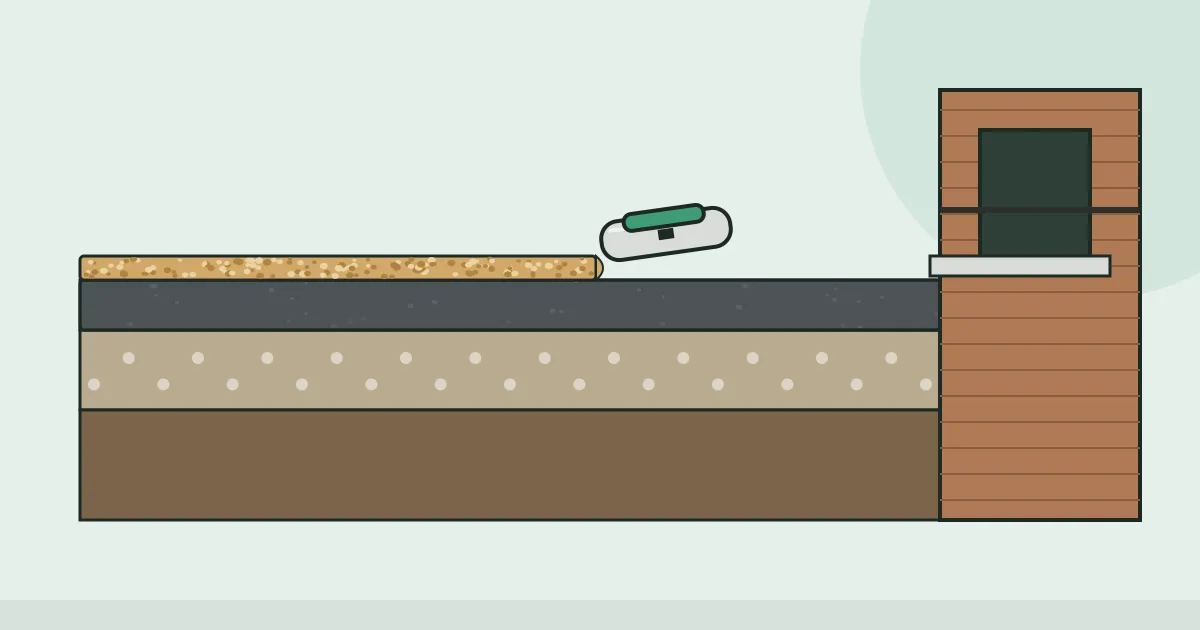
Yes, often. Resin bound is a thin surface, usually around 15–18mm, and it needs a solid, stable base to sit on. An existing tarmac or concrete drive can be that base, which saves the excavation, sub-base and new base course that make up much of the cost of a full rebuild. On our resin bound driveway cost guide that's the difference between the two resurfacing bands (roughly £3,500 to £6,500) and the new-base band at £6,500 to £8,000 or more.
The catch is that resin doesn't fix anything underneath it. It copies the base, faults and all. So the real question isn't whether resin can go over your drive. It's whether your drive is good enough to keep.
Four things the old drive has to get right
What an installer should check before agreeing to overlay an existing driveway with resin bound.
| Check | Overlay is likely to work if… | Overlay is likely to fail if… |
|---|---|---|
| Structure | The drive is solid underfoot, with no sunken patches or rocking sections | There are dips in the wheel tracks or areas that move when you stand on them |
| Cracks | Any cracks are fine, stable and limited to the surface | Cracks are wide, crazed, spreading, or one side sits higher than the other |
| Fall | Rain runs off and away from the house without puddling | Water sits on the drive for hours, or runs towards the house |
| Surface | The tarmac is intact or the concrete is clean and sound | Tarmac is crumbling and losing stone, or concrete is scaling and flaking |
Cracks that come up from the base are the big one. Resin bound has some flexibility but it can't bridge movement, so a crack in the old drive will usually reappear in the new surface, sometimes within a winter or two. Our checklist of signs you need a new driveway helps tell a tired surface from a failed base.
Tarmac and concrete behave differently
Over tarmac, the main worries are fretting (where the surface is losing stone) and soft spots. Fretting areas need cleaning back and repairing first. Fresh tarmac also needs time before resin goes on, so if a new base course is being laid as part of the job, the installer will want it to cure first.
Over concrete, the issue is joints. A concrete drive is cut into bays with expansion or control joints so it can move. If resin is laid straight across those joints, the movement tends to show up as a straight crack along each one. A careful installer will either carry the joint through the resin or use a crack-bridging treatment over it, and should be able to tell you which.
The level change people forget
An overlay raises the drive. Even 15–18mm can matter at the edges:
- Door thresholds and garage doors, where the new surface may come up to or above the sill.
- The damp-proof course. Ground levels next to the house are normally kept well below it, commonly around 150mm. If the old drive was already close, raising it can bridge the DPC and let damp into the wall.
- Manhole and drain covers, which may need raising frames so they sit flush.
- Where the drive meets the pavement or a neighbour's drive, so there isn't a lip to trip on or catch a tyre.
Where these are tight, the usual answer is to cut back a strip of the old surface along the house and set the resin flush there, or to add a drainage channel. Whichever it is, it belongs on the quote.
Drainage: permeable on top, sealed underneath
Resin bound is permeable, but old tarmac and concrete aren't. Water drains through the resin and then runs along the top of the old base to its lowest edge. That works if the old drive already falls towards a lawn, border or drain. If it fell towards the road, it still will, and the drive is effectively impermeable for planning purposes. Our guide to permeable vs impermeable driveways explains why that matters in a front garden over 5 square metres.
Resin bonded works the other way round: the resin goes down first as a coating and the stone is thrown onto it while it's wet. It's cheaper and can look similar in photos, but it isn't permeable and tends to shed stone. If a quote for "resin" over your old drive looks much cheaper than the others, check which one it is. Our resin bound driveways page covers bound versus bonded too.
If the drive doesn't pass
A failed base doesn't rule out resin. It means the job moves into the new-base band: the old surface comes out, the sub-base is rebuilt and a new tarmac or concrete base goes down before the resin. At that point it's also worth pricing the alternatives properly, because you're paying for a full rebuild either way. Our comparison of resin bound vs block paving is a good place to start.
How to check your driveway before asking for a resin overlay quote
- Wait for rain, then look
After a heavy shower, note where water lies and for how long, and which way it runs. Photograph any puddles.
- Walk the drive slowly
Feel for soft spots, dips in the wheel tracks and anything that moves underfoot. Mark them with chalk.
- Map the cracks
Note whether cracks are hairline or wide, single or crazed, and whether one side is higher than the other. Photograph them with a coin for scale.
- Check the edges against the house
Measure from the drive surface to the damp-proof course and look at door thresholds and drain covers that a 15–18mm overlay would affect.
- Share it with installers
Send the photos and notes when asking for quotes, and ask each installer to say in writing whether they would overlay or rebuild, and what repairs they would make first.
Frequently asked questions
Can I have resin laid on top of my block paving?
It's generally not recommended. Block paving moves slightly as individual units, and that movement tends to crack a thin resin layer along the joint lines. Most installers would lift the blocks and lay a new base instead.
How long does a resin overlay take?
On a sound base that needs little repair, many drives are cleaned, primed and laid in a day or two, with vehicles kept off for around 24–48 hours depending on the weather. Repairs and edge work add time.
Will cracks in my tarmac come through the resin?
Cracks caused by base movement usually will. Fine, stable surface cracks can often be repaired before laying. If the installer can't tell you which kind your cracks are, ask them to look again before quoting.
Does resin over tarmac need planning permission?
It depends on where the water goes. Resin over a sealed base drains along the old surface, so in England a front drive over 5 square metres that sheds water onto the road can still need permission. Sending the water to a border, lawn or soakaway on your own land avoids this.
Ready to talk to an asphalt/tarmac driveways specialist?
Get Free Quotes →