
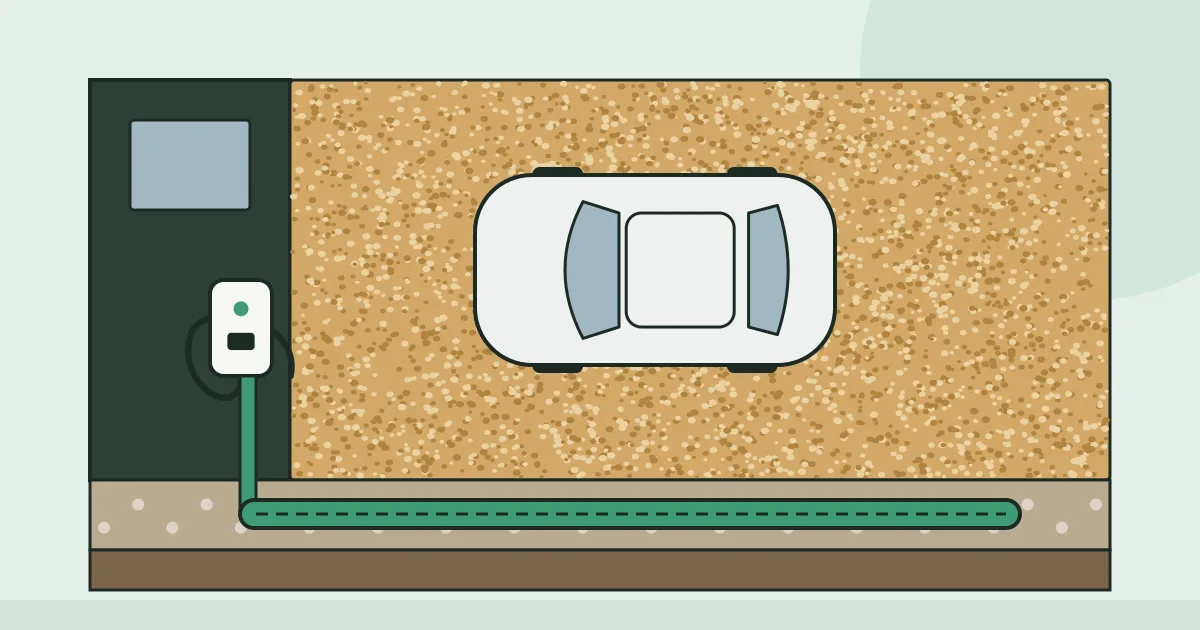
Buying an electric car is one of the most common reasons people end up getting a new driveway. Charging at home is usually the cheapest and most convenient way to run an EV. In most cases, though, it needs a car parked off the road, next to a charger on your own property. Running a cable across the pavement to a car in the street is generally not allowed, because of the trip hazard to pedestrians.
If you're creating a new drive, or replacing an old one, it's the one moment when putting in a charging cable costs almost nothing extra. Once the surface is down, the same cable means cutting a trench through a finished drive. This guide covers what to plan and in what order, and how each of the six surfaces we cover copes.
This guide covers the driveway side of the job. The charger and its wiring must be installed by a qualified electrician. Your driveway contractor lays the duct and the surface, and your charger installer pulls the cable through and connects it. Funding and grant schemes for home chargers change regularly, so check the current position with the Office for Zero Emission Vehicles rather than relying on figures quoted elsewhere.
Where will the charger go?
Most home chargers are mounted on the front wall of the house, close to the meter or consumer unit, because that keeps the cable run short. That works when the drive runs alongside the house. It works less well when the parking space is at the far end of a long front garden, or on a separate hardstanding. There, the charger is usually mounted on a post near the car and fed by an armoured cable buried in a duct under the drive.
Think about where the car's charging port sits and which way you'll park. A charger mounted at the wrong end of the space means stretching the cable across the drive or reversing in every time. Tethered chargers come with a fixed cable, commonly a few metres long. If yours won't comfortably reach the port from where you park, the charger or the space needs to move.
Lay a duct before the surface goes down
Even if you haven't bought the car yet, ask your driveway contractor to lay a length of cable duct under the new drive, from the house to wherever a post charger or a future gate might go. Mark both ends. It's a small addition during excavation, when the ground is already open, and it saves disturbing a finished surface later. The same applies to cables for driveway lighting or electric gates.
How each surface copes
How easily each surface can be opened up and reinstated for a cable run after it's laid. A duct laid in advance avoids the question entirely.
| Surface | Adding a cable later | Notes for EV owners |
|---|---|---|
| Gravel | Easy | Stone can be raked back and replaced. Grids lift out. A heavier car can rut loose gravel, so a grid is worth having. |
| Block paving | Moderate | Blocks can be lifted along the route and relaid, though the sand bed and sub-base need re-compacting properly. |
| Slab paving | Moderate | Slabs can be lifted, but mortar-bedded slabs often break. Keep spares from the original batch. |
| Tarmac | Harder | A trench has to be cut and patched, and the patch usually shows. |
| Resin bound | Hard | Cutting through resin and its base leaves a visible repair that's difficult to colour-match. |
| Concrete | Hardest | A trench has to be saw-cut through the slab and reinforcement, which is noisy, dusty and obvious afterwards. |
Many electric cars are heavier than a comparable petrol or diesel car, because of their batteries. That's not a reason to avoid any particular surface, but it's another reason not to skimp on the sub-base. Gravel without a grid and slabs laid to patio specification are the two builds most likely to show it.
Planning and the dropped kerb
Creating new off-street parking often raises two permissions. The first is the front-garden surfacing rule. In England, more than 5 square metres of impermeable surface draining onto the road needs planning permission, while permeable surfaces like gravel and resin bound generally don't. The gov.uk guidance on paving a front garden explains it, and the other UK nations set their own rules. The second is a dropped kerb. You need council consent to drive across the pavement, and some councils refuse a crossing where the front garden is too shallow to park in without overhanging the path. Check this with the council before committing to a drive layout. The gov.uk dropped kerb page links to your council's process.
Putting it in order
The steps below put the jobs in a sensible order. Use our guide to the types of driveway to choose a surface, and the driveway surface cost calculator for a first price. If you're replacing an existing drive, our checklist of signs you need a new driveway will tell you whether yours can be kept as a base.
How to plan a new driveway for home EV charging
- Check the dropped kerb first
If you don't already have vehicle access across the pavement, check your council's dropped-kerb criteria before designing anything. Whether you can get a crossing decides whether the drive works at all.
- Decide where the car will park and charge
Mark the parking space and the side the car's charging port will face. Choose a wall or post position for the charger that the cable can reach without crossing a walkway.
- Get the electrician to survey
Ask a qualified charger installer to confirm the supply, the charger position and the cable route before the driveway starts. They can tell you what size of duct they want laid.
- Choose the surface with planning in mind
On a front garden in England, decide whether to use a permeable surface or to design an impermeable one to drain into your own garden or a soakaway, so the drive stays within the planning rules.
- Have the duct laid during the driveway works
Ask the driveway contractor to lay the duct at the agreed depth during excavation, with draw cord inside and both ends marked, before the sub-base and surface go down.
- Install the charger once the drive is finished
Once the surface has cured, the electrician pulls the cable through the duct, fits the charger and connects it, with no need to disturb the new drive.
Frequently asked questions
Do I need a driveway to charge an electric car at home?
In most cases you need off-street parking on your own property, because trailing a charging cable across a public pavement is generally not permitted. Some councils are trialling cable channels in the pavement, but these aren't widely available. Check with your council if you have no driveway.
Which driveway surface is best for an electric car?
Any of the six common surfaces can carry an electric car if the sub-base is built properly. If you think you might need to add or move a cable later, gravel and block paving are the easiest to lift and reinstate. The simplest answer is to lay a duct before the surface goes down, whatever you choose.
Can my driveway contractor install the EV charger?
Usually not. The charger and its electrical connection need a qualified electrician. The driveway contractor can lay the duct the cable will run through, so the two trades should agree the route and depth before the driveway work starts.
Is there a grant for a home EV charger?
Government support for chargers has changed several times and depends on your circumstances, for example whether you own or rent and whether you live in a flat or a house. Check the current schemes through official government sources rather than relying on figures quoted by installers or older articles.
Ready to talk to an asphalt/tarmac driveways specialist?
Get Free Quotes →