
What Is Patio and Slab Paving?
Patio and slab paving covers the installation of large, flat paving slabs — concrete, porcelain or natural stone — laid on a prepared sub-base and bedding layer to create a hard, level surface, whether that's a garden patio for sitting out on or a slabbed driveway for parking. Slabs are laid individually with pointed joints between them, giving a cleaner, more uniform look than block paving, with fewer joint lines to maintain.
A new patio tends to get booked when a garden needs a proper outdoor space for furniture, a barbecue or simply somewhere flat to sit, while slab-paved driveways are typically chosen for a smarter, more contemporary look than tarmac or block paving, particularly with porcelain or large-format slabs.
Signs You Need New Patio or Slab Paving
- Slabs that rock, wobble or sit unevenly when stepped or driven on
- Cracked, chipped or badly stained slabs that cleaning no longer improves
- Weeds or moss growing up through failed or missing pointing between joints
- Sunken areas or standing puddles after rain, suggesting the sub-base has settled
- A patio or slabbed area that's simply the wrong size, shape or layout for how the space is actually used
If the slabs are part of a driveway rather than a patio, our driveway warning signs checklist helps you work out whether it's the slabs, the joints or the base underneath that has failed.
Patio and Slab Paving Options Explained
The main choice with slab paving is material, and each has a different look, price point and maintenance level:
- Concrete slabs — the most budget-friendly option, available in a wide range of colours and textures, including riven finishes designed to look like natural stone.
- Natural stone (sandstone, limestone, granite) — a premium option with genuine variation in colour and texture between slabs, generally more expensive and, depending on the stone, sometimes needing periodic sealing.
- Porcelain — a dense, low-porosity slab that resists staining and frost damage well and needs very little upkeep, though it typically sits at the higher end of the price range.
Slab size matters too — large-format slabs give a cleaner, more contemporary look with fewer joints, but they're heavier and less forgiving to lay well, so installation cost is usually a little higher than for standard-size slabs.
For a front drive, slabs are one of six common surface choices — our guide to the types of driveway compares them all.
What to Include When Asking for a Quote
Give a rough size and sketch of the area, what surface is there now, and how you intend to use the finished space, since this is what most quotes are actually priced against. Flag anything that could affect access — a narrow side entrance, overhead cables, a shared driveway — and mention drains or level changes nearby, so quotes for different surface materials are actually comparing like for like.
For patios and slab paving, have the contractor confirm in writing exactly which system and materials are being used, since specifications vary between suppliers. The spec should cover the sub-base depth, edge restraints or kerb line, how the finished surface manages rainwater, and whether reinstatement of the surrounding lawn, fencing or paving is included.
When comparing quotes side by side, check they're covering the same ground: excavation depth, sub-base specification, surface material, edging and drainage should all be named, not folded into a single price per square metre. Ask each contractor to confirm separately whether spoil removal, permits and reinstatement around the edges are included, since this is where otherwise-similar quotes can differ most.
How Much Does Patio and Slab Paving Cost?
| Area | Typical cost |
|---|---|
| Small patio / area | £2,000 – £3,500 |
| Medium patio or slabbed driveway | £3,500 – £5,000 |
| Large area, natural stone or porcelain | £5,000 – £6,000+ |
These are ballpark UK figures rather than a quote — slab material, size, sub-base condition and access to the site all affect the final price. A local contractor can give you an accurate figure once they've seen the area and discussed materials with you. Our slab paving cost guide explains why a slabbed driveway costs more than a patio of the same size, and the driveway surface cost calculator gives a quick ballpark for each surface.
The Patio and Slab Paving Process: What to Expect
- Site survey and design. The contractor measures the area, checks existing levels and drainage, and discusses slab material, size and layout with you.
- Excavation. The area is dug out to the required depth, removing any old surface, turf or unsuitable soil.
- Sub-base and bedding. A compacted stone sub-base is laid, followed by a mortar or sand bedding layer for the slabs to sit on.
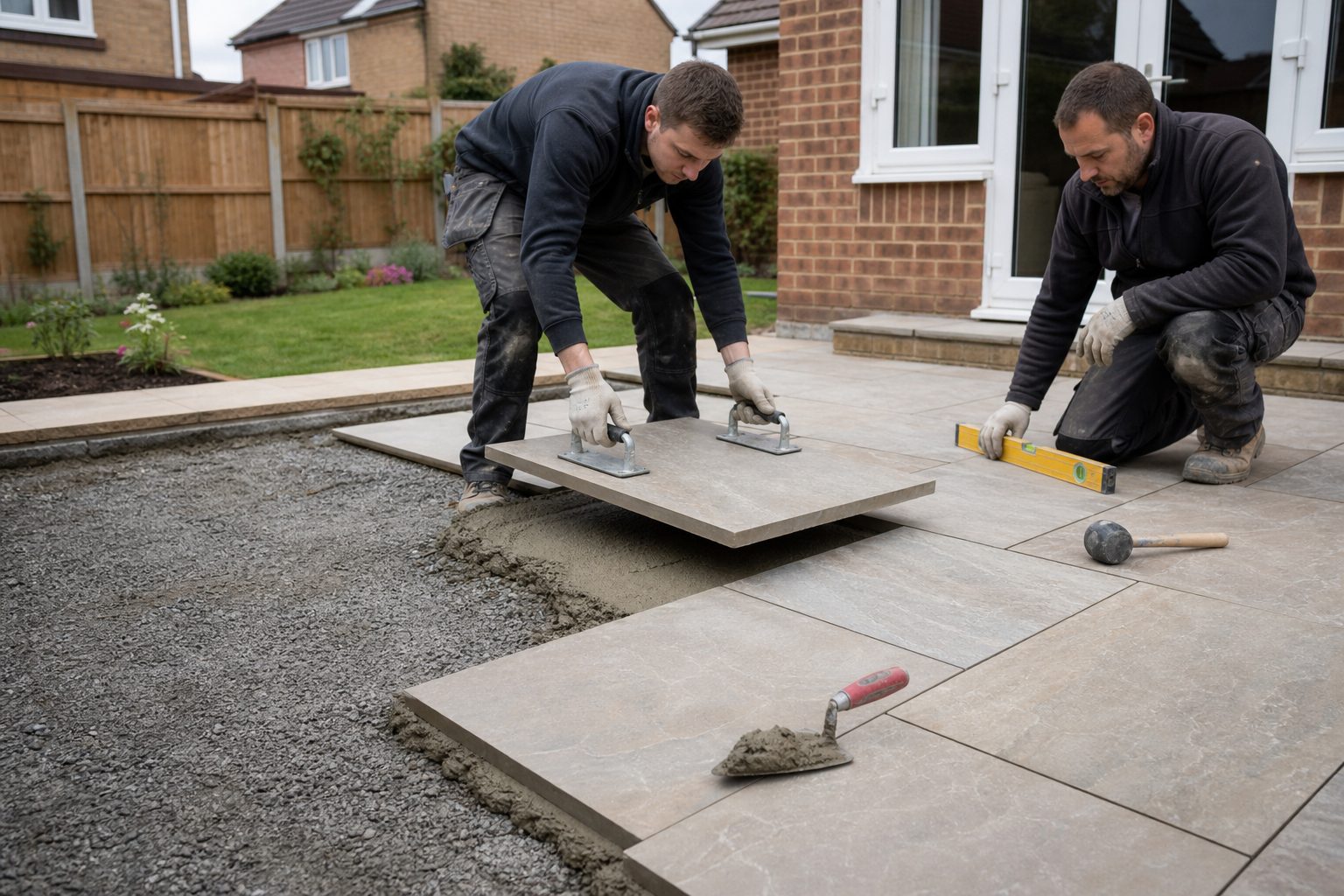
- Laying the slabs. Each slab is laid, levelled and tapped into place, with cuts made around edges and any obstacles.
- Pointing and finishing. Joints between slabs are pointed with mortar or a flexible jointing compound, and the area is left to cure before use.
Planning Permission for Patios and Slab Paving
The rules here depend heavily on where the paving goes. A patio in a back garden generally doesn't need planning permission at all, regardless of size or material, since the front-garden hard surfacing rules that apply to driveways don't extend to rear gardens — the main things to watch are not covering more than 50% of the garden with hard surfacing or extensions combined, and not building within permitted development limits near boundaries if the patio includes raised decking or a structure. A slab-paved driveway at the front of a property is a different matter: if the slabs are impermeable (most concrete and porcelain paving laid with sealed mortar joints are) and the area exceeds 5 square metres draining onto the road, planning permission is required in England, in the same way as tarmac or standard block paving. Using a permeable jointing system or directing run-off to a soakaway can avoid this. Check the gov.uk guidance on paving a front garden if you're planning a slabbed driveway specifically.
How to Choose a Patio and Paving Specialist
- Ask what sub-base and bedding method they'll use, particularly if the area will take vehicle weight rather than just foot traffic
- Check whether the quote specifies slab material, size and brand, not just "paving slabs" generically
- Confirm whether pointing is mortar or a flexible jointing compound, and how it's expected to perform over time
- Ask to see previous patios or slabbed driveways they've completed, ideally a couple of years old
- Get at least two quotes and make sure both are based on the same slab spec and area size
Frequently Asked Questions
Do I need planning permission for a patio?
Usually not for a back garden patio, regardless of size or material. A slabbed driveway at the front of the property is treated differently — if it's impermeable and over 5 square metres draining onto the road, planning permission is needed in England.
What's the difference between porcelain and natural stone paving?
Porcelain is a manufactured slab that's very consistent in colour, resists staining and frost damage well, and needs little maintenance. Natural stone has genuine variation between slabs and a more organic look, but can need periodic sealing depending on the stone type.
How long does patio paving last?
A well-laid patio on a proper sub-base typically lasts 20 years or more, with most issues over time coming from failed pointing or a settled sub-base rather than the slabs themselves wearing out.
How much does a new patio cost on average?
Most UK patios and slab-paved areas cost between £2,000 and £6,000, depending on size and slab material. Get a free quote from local installers for an exact price.