
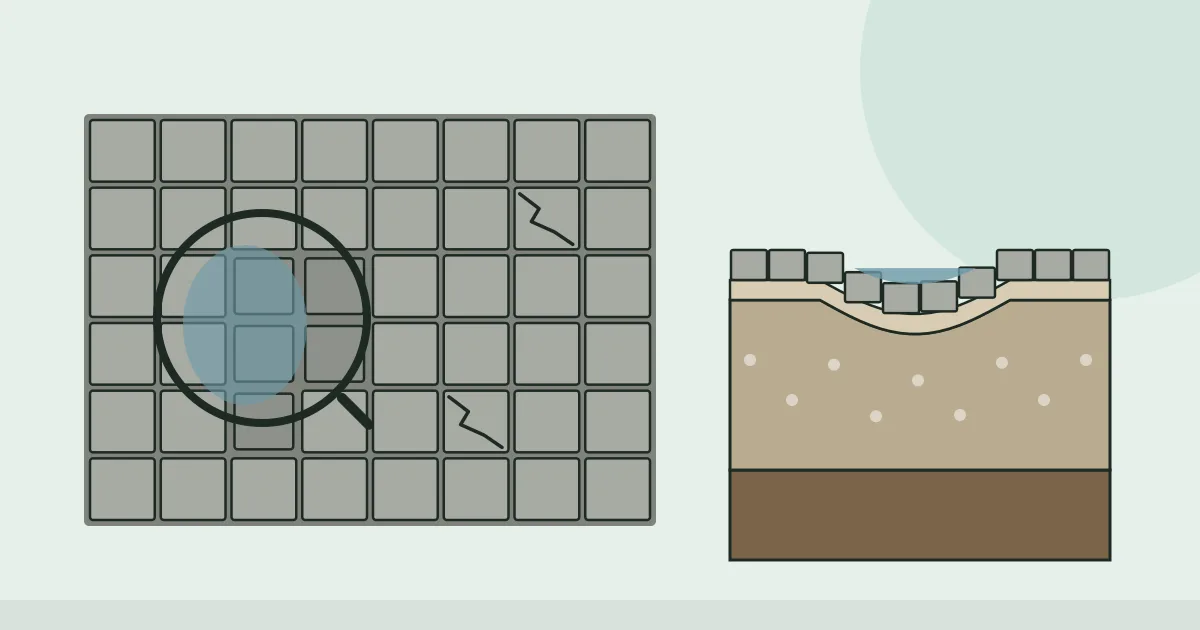
Every driveway wears. The question is whether what you're seeing is the surface ageing, which can often be fixed or overlaid, or the structure underneath failing, which usually means starting again. The two can look similar from the front door. This guide helps you tell them apart for the surface you actually have, because a crack in tarmac and a crack in concrete mean different things.
Start with the 20-minute check at the end of this guide, then read the section for your surface.
Surface problem or base problem?
Almost every driveway sign falls into one of two groups:
What common driveway symptoms usually point to. A contractor's inspection is the only way to be sure for your drive.
| What you see | Usually points to | Overlay still possible? |
|---|---|---|
| Fading, patchy colour, dull finish | Surface ageing | Often yes, if the base is sound |
| Loose stones, a crumbly texture | Surface binder wearing out | Sometimes, after repair |
| Fine hairline cracks in straight lines | Normal shrinkage or control joints | Often yes |
| Spreading, crazed or 'map' cracks | Base or sub-base failing | Rarely |
| Sunken dips, especially in wheel tracks | Sub-base settling or washed out | No, the base needs rebuilding |
| Standing water in the same places | Lost fall, settlement or blocked drainage | Rarely, without correcting levels |
| Edges breaking away | Missing or failed edge restraint | Sometimes, if edging is rebuilt |
The surface problems in the top half are why resin bound is so often laid over a tired but sound tarmac or concrete drive. The base problems in the bottom half are why that doesn't always work. Resin, or new tarmac, laid over a failing base carries the failure straight up into the new surface.
Tarmac: watch for spreading cracks and potholes
- Crazed cracking that spreads outwards in a web, rather than a single clean line, usually means the sub-base has lost its strength.
- Potholes and sunken patches mean water has got in and the base underneath has moved or washed out.
- A gravelly, crumbling texture shows the binder at the surface is worn. On its own that's an ageing surface, not a failed drive.
- Crumbling edges where the tarmac meets the lawn usually mean there's no proper edge restraint.
Widespread crazing and potholes usually mean a new tarmac driveway or another surface on a rebuilt base. A tired but flat and crack-free tarmac drive may be a good candidate for a resin overlay.
Block paving: rocking blocks and sinking tracks
- Blocks that rock underfoot, or dips along the wheel tracks, point to a failed sub-base in those areas.
- Jointing sand washing out and gaps widening between blocks lets the blocks creep and loosen.
- Persistent weeds and moss in the joints are a maintenance issue on their own, but they speed up joint loss.
- Cracked, chipped or badly faded blocks are cosmetic unless they're widespread.
Block paving is the easiest surface to repair locally. A sunken area can be lifted, the base corrected and the same blocks relaid. It's time for a new drive when the problems cover most of the surface, or the blocks themselves are past saving.
Concrete: the width and pattern of the cracks
- Fine hairlines and cracks along the cut control joints are normal. The joints are there to make concrete crack neatly.
- Wide cracks that cross the slab randomly, or where one side sits higher than the other, suggest ground movement or a slab that's too thin for its load.
- Whole sections that have sunk, tilted or lifted relative to the rest need breaking out.
- Surface scaling or flaking is often frost or de-icing salt damage. It's unsightly and gets worse, but it's a surface problem.
A concrete driveway with only surface wear and a few stable cracks can often take a resin overlay once the cracks are repaired. A slab that's moving can't.
Gravel: ruts, bald patches and weeds
- Ruts and bald patches where tyres have pushed the stone aside are the classic sign of gravel laid without a stabilisation grid.
- Stone spreading onto the lawn or pavement means the edging has failed or was never fitted.
- Weeds pushing through suggest the membrane has torn or is missing.
- Mud or standing water after rain means the sub-base underneath is inadequate.
Topping up with stone treats the first sign for a while. Mud, water and constant rutting mean the build underneath needs redoing, ideally with a grid. See our gravel driveways page.
Resin: patchiness, cracking and slow drainage
- Patchy, uneven fading or a lost sheen can come from a resin that isn't UV-stable.
- Cracks through the resin almost always come from the base underneath moving.
- Water ponding on a surface that should drain suggests it was laid too thick, or the base has lost its fall.
- Loose stones and a crunchy feel usually mean it's actually resin bonded, not resin bound.
Slabbed driveways follow the same logic as block paving: rocking or sunken slabs point to the base, failed pointing to the joints. Our slab paving page covers what a vehicle-grade slab build involves.
Take photos after heavy rain, when puddles show exactly where the levels have gone, and note which problems are spreading. A contractor can then tell you quickly whether you're looking at a surface refresh, a partial rebuild or a new drive. The resin bound cost guide explains what an overlay costs if your base passes.
The 20-minute driveway check
The steps below are a simple way to inspect any driveway surface. Do it after a spell of rain if you can. For the next step, our guide to the types of driveway compares your options, and the driveway surface cost calculator gives a first price for each.
How to check whether your driveway needs replacing
- Look after rain
Within an hour of heavy rain, walk the drive and note every place water is sitting. Standing water in the same spots each time points to settlement or a lost fall rather than a surface problem.
- Walk the wheel tracks
Walk slowly along the lines where tyres run. Feel for dips, rocking blocks or slabs, and soft or rutted gravel. Wheel tracks show sub-base failure first because they carry the most load.
- Read the cracks
Check whether cracks are fine and straight, following control joints, or wide, branching and crazed. Note whether one side of a crack sits higher than the other, which suggests movement underneath.
- Check the edges
Walk the perimeter. Look for crumbling tarmac edges, loose edging blocks, gravel spilling onto the lawn or pavement, and gaps between the drive and walls.
- Check the joints and texture
On block paving and slabs, look for missing jointing sand, weeds and loose units. On tarmac and resin, rub the surface with your shoe to see whether stones come loose.
- Compare with the table
Sort what you found into surface problems and base problems using the table above. Mostly surface problems suggest a repair or overlay may work. Base problems across much of the drive suggest a new driveway.
Frequently asked questions
How do I know if my driveway needs replacing or just repairing?
Look at whether the problems are in the surface or the base. Fading, a worn texture and a few fine cracks are surface ageing and can often be repaired or overlaid. Widespread crazed cracking, sunken wheel tracks and water that always sits in the same places point to a failed sub-base, which usually means a new drive.
Can I put a new surface over my old driveway?
Often, if the old drive is structurally sound. Resin bound is commonly laid over existing tarmac or concrete, and tarmac can sometimes be overlaid too. It won't work over a base that's moving, cracking through or holding water, and the finished level has to stay clear of the house's damp-proof course and thresholds.
Are cracks in a concrete driveway a problem?
Not always. Concrete is expected to crack a little, which is why control joints are cut into it. Fine, straight cracks along those joints are normal. Wide random cracks, or cracks where the two sides sit at different heights, suggest ground movement or an under-specified slab and are worth having looked at.
Why does my block paving keep sinking in the same place?
Usually because the sub-base or sand bed underneath has settled or washed out in that area, often where a car's wheels regularly stop or where water gets in. Relaying the blocks alone won't last. The base underneath needs correcting before the blocks go back down.
Ready to talk to an asphalt/tarmac driveways specialist?
Get Free Quotes →