
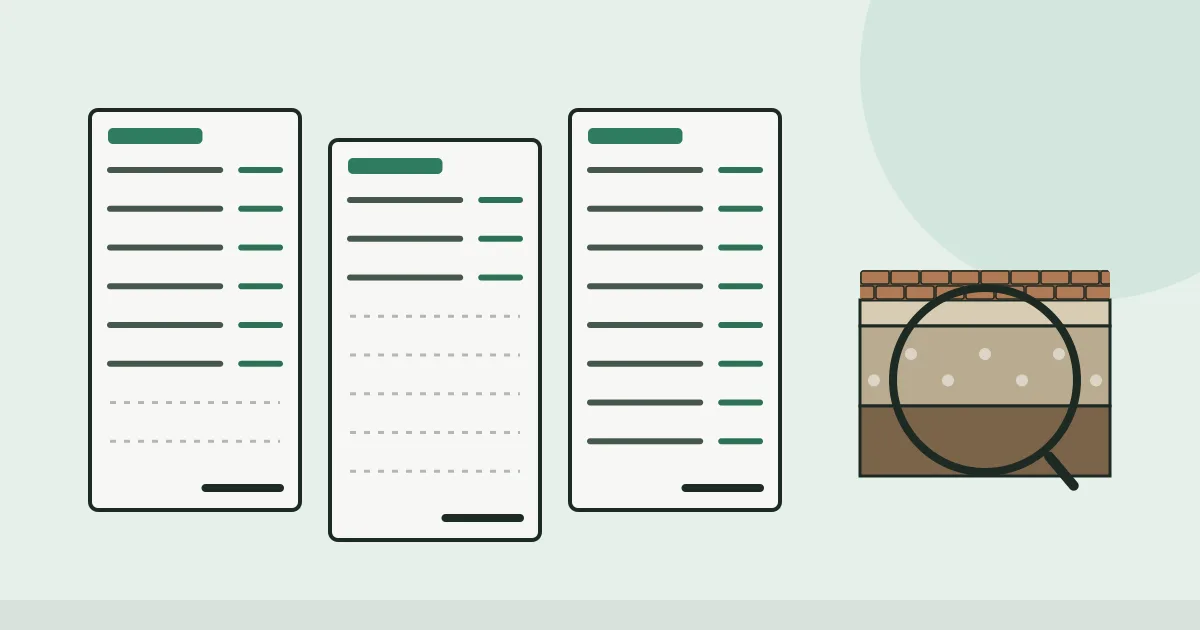
Two honest quotes for the same drive can still differ by thousands of pounds. One may include a deeper dig, proper edging and taking the old surface away; the other may assume the old base stays and leave the skip to you. Until each quote says what it covers, the totals can't be compared.
This guide is a line-by-line list of what a written driveway quote should state, whichever of the six surfaces you're having laid. It's about the specification, not about finding the cheapest price. The cheapest quote is sometimes the best one. You just need to know what's in it.
What every quote should spell out
The lines a driveway quote should cover, what a clear version looks like, and what a vague one tends to say instead.
| Line | A clear quote says | A vague quote says |
|---|---|---|
| Area | The measured area in square metres, ideally with a sketch | "Front drive" |
| Excavation | How deep they'll dig and what comes out (old surface, topsoil, roots) | "Prepare ground" |
| Sub-base | Compacted depth, material (for example Type 1), membrane if used | "Full sub-base" |
| Edging | Type of kerb or edging, how it's bedded, and how many metres | Nothing, or "edging as required" |
| Drainage | Which way the drive falls, where the water goes, any channel drain or soakaway | Nothing |
| Surface | Product, colour, thickness or depth, laying pattern where relevant | "Block paving" or "resin" |
| Waste | Removal of spoil and old surface included, with how it's disposed of | Not mentioned, which often means extra |
| Reinstatement | Making good lawn, borders, fence bases and the pavement edge | Not mentioned |
| Drive-on time | When you can walk on it and when you can park on it | Not mentioned |
| Guarantee | What it covers, for how long and who stands behind it | "Fully guaranteed" |
Surface-specific details matter too. For tarmac, ask whether it's one course or two. For block paving, the block make, colour and pattern. For concrete, slab thickness and reinforcement. For resin bound, whether it's an overlay or a new base, and that it's bound rather than bonded. For gravel, the stone type and size and whether a grid is included.
The sub-base line is the one to push on
The sub-base is buried by the end of day one, so nobody sees it again, and it's the layer that decides whether the drive sinks, ruts or cracks. That makes it the easiest place for a low price to come from. If one quote is much cheaper than the rest, compare the excavation and sub-base lines first. Our guide to the driveway sub-base explains what typical depths look like and how to check the work while it's going in.
Things that are often priced separately
- A dropped kerb. This needs the council's consent and is often done by the council or an approved contractor, so most driveway quotes leave it out.
- Planning permission, if your drive needs it. An impermeable surface over 5 square metres draining onto the road needs an application in England. Our guide to permeable vs impermeable driveways explains the alternatives.
- Moving or raising manhole covers, gullies and inspection chambers.
- Unexpected ground. Old foundations, buried rubble or very soft clay found during the dig. Ask how the contractor prices that if it happens, before you sign.
- Skip permits, needed when there's no room for the skip on your own property and it goes on the highway.
Write the lines from the table above down the side of a page and put each quote in a column. Where a quote leaves a line blank, ask that contractor to fill it in. Once every column is complete, the prices usually start to make sense. Our driveway surface cost calculator gives a rough range for each surface if you want a sense check.
Payment, paperwork and your rights
A written quote or contract is worth having for its own sake. Under the Consumer Rights Act 2015, a trader must carry out a service with reasonable care and skill, and what's written in the quote becomes part of what was agreed. A clear specification makes it far easier to show that something wasn't done.
- Deposits. Some contractors ask for one to order materials. A modest deposit for specific materials is normal; a large share of the price up front before anything is delivered is a reason to ask questions.
- Cancellation. If you agree the contract in your home rather than at the contractor's premises, you normally have 14 days to cancel under the Consumer Contracts Regulations. If you ask them to start within that time, you may have to pay for work already done.
- Guarantees. Ask what's covered (sinking, cracking, colour, workmanship), for how long, and what happens if the company stops trading. Some guarantees are backed by insurance; many aren't.
- Insurance. A contractor working on your property should carry public liability insurance. It's reasonable to ask to see it.
One warning, briefly: a trader who knocks on the door with leftover tarmac and a price for today only is not giving you a quote you can compare. Citizens Advice has guidance on consumer problems if a job goes wrong.
Choosing between complete quotes
Once the specifications line up, price is only part of it. Look at how well each contractor explained the job, whether they looked at drainage without being asked, and whether they can show you drives they laid a few years ago. If you're still deciding on the surface itself, our guide to the types of driveway compares all six on cost, lifespan and upkeep.
How to compare driveway quotes like for like
- Give every contractor the same brief
Share the same measurements, photos, surface preference and notes on access, drains and levels, so each quote is priced against the same job.
- Ask for an itemised written quote
Request that each quote lists excavation, sub-base, edging, drainage, surface, waste removal and reinstatement separately.
- Lay the quotes out side by side
Put the line items down one side of a page and each contractor's answer in its own column.
- Fill the gaps
Where a line is missing or vague, go back to that contractor and ask them to confirm in writing what's included.
- Compare the sub-base and drainage first
Check the compacted sub-base depth and where the water will go, since these are the parts you can't inspect later.
- Check terms before you sign
Confirm the deposit, payment stages, guarantee terms, start date and drive-on time, and keep a copy of the final agreed specification.
Frequently asked questions
How many driveway quotes should I get?
Three is a sensible number for most drives. Fewer makes it hard to tell whether a price is reasonable; many more takes a lot of time and the extra quotes rarely change the picture.
Why are driveway quotes so different?
Usually because they're quoting different jobs. Excavation depth, sub-base, edging, drainage and waste removal can vary a lot between contractors and are often left out of the headline figure. Ask each one to itemise the work.
Should a driveway quote include VAT?
It should say clearly whether VAT is included. A sole trader who isn't VAT registered adds nothing for it, so two quotes can be 20% apart for that reason alone. Check before comparing totals.
Is a price per square metre a good way to compare quotes?
Only as a rough check. A rate per square metre can hide differences in excavation depth, edging and drainage, so two similar rates can still be for quite different builds.
Ready to talk to an asphalt/tarmac driveways specialist?
Get Free Quotes →